Scaling and Fouling in Industrial Systems: How Acid Selection Impacts Equipment Life
Introduction to Scaling and Fouling in Industrial Systems
Scaling and fouling are among the most persistent challenges in industrial operations that rely on heat transfer, fluid circulation, or continuous chemical processing. From heat exchangers and boilers to reactors and pipelines, unwanted deposits gradually accumulate on internal surfaces, reducing performance and shortening equipment life. While often treated as routine maintenance issues, scaling and fouling have far-reaching consequences when left unmanaged.
Scaling refers to the crystallization and deposition of dissolved minerals, typically from water-based systems, forming hard, adherent layers. Fouling is broader in scope, encompassing organic matter, corrosion products, biological growth, and process residues. Both phenomena restrict flow, impair heat transfer, and create localized environments that accelerate corrosion.
What makes scaling and fouling particularly problematic is their silent progression. Performance losses often develop gradually, masking the root cause until energy costs rise, product quality suffers, or unplanned shutdowns occur. In many cases, the corrective action - chemical cleaning - comes too late or is performed incorrectly, introducing new risks to equipment integrity.
Chemical treatment, especially acid cleaning, plays a central role in controlling and removing these deposits. However, acid selection is not a neutral decision. The wrong acid, concentration, or exposure time can damage metallurgy, increase corrosion rates, and reduce the remaining service life of valuable assets. Understanding how scaling and fouling form - and how acid choice influences outcomes - is essential for long-term operational reliability.
What is scaling in industrial equipment?
Scaling is the formation of hard, crystalline mineral deposits on internal equipment surfaces. It commonly results from calcium carbonate, calcium sulfate, silica, or mixed salts precipitating out of solution when solubility limits are exceeded.
What is fouling and how it differs from scaling
Fouling includes any unwanted buildup on surfaces, such as organic residues, biofilms, corrosion products, or process by-products. Unlike scale, fouling deposits are often softer, layered, and chemically complex.
Why scaling and fouling are critical operational challenges
Both restrict flow, reduce heat transfer efficiency, and promote under-deposit corrosion, leading to higher operating costs and premature equipment failure.
Common Causes of Scaling and Fouling
Scaling and fouling rarely originate from a single factor. Instead, they develop due to an interaction between water chemistry, process conditions, and system design. Understanding these root causes is the first step toward selecting effective cleaning and prevention strategies.
Mineral deposition (calcium carbonate, silica, sulfates)
Mineral scaling occurs when dissolved salts exceed their solubility limits. Calcium carbonate is the most common culprit, forming rapidly in systems with hard water and elevated temperatures. Calcium sulfate scales are harder and more resistant to removal, while silica deposits are particularly problematic due to their glass-like structure and chemical inertness. Mixed mineral scales often form layered deposits that complicate chemical cleaning.
Biological fouling and microbial growth
In cooling systems and low-temperature circuits, microorganisms can colonize surfaces and form biofilms. These biofilms trap particulates, protect bacteria from biocides, and create differential oxygen zones that accelerate localized corrosion beneath deposits.
Process conditions that accelerate buildup (temperature, pH, flow rate)
High temperatures reduce mineral solubility, while low flow rates allow deposits to settle and adhere. pH fluctuations can trigger precipitation or destabilize previously soluble compounds. Turbulence, dead zones, and poor hydraulic design further contribute to uneven deposit formation.
Water quality and contamination issues
Poorly treated makeup water, process contamination, or carryover of suspended solids introduces additional scaling and fouling precursors. Even trace impurities can accumulate over time, forming significant deposits in closed-loop systems.
Impact of Scaling and Fouling on Equipment Life
The consequences of scaling and fouling extend far beyond surface cleanliness. Over time, deposits fundamentally alter how equipment operates and ages.
Reduced heat transfer efficiency
Even thin layers of scale act as thermal insulators. A few millimeters of calcium carbonate can reduce heat transfer efficiency by more than 10–15%, forcing systems to work harder to achieve the same output.
Increased energy consumption
As heat transfer efficiency drops, energy input must increase. Boilers consume more fuel, chillers draw more electricity, and pumps require higher power to overcome flow restrictions.
Corrosion under deposits
Deposits create stagnant micro-environments where corrosive species concentrate. Oxygen differentials and pH shifts beneath scale lead to pitting and crevice corrosion that remain hidden until failure occurs.
Premature equipment failure and downtime
Unchecked scaling and fouling accelerate tube leaks, exchanger failures, and blocked pipelines, often resulting in unplanned shutdowns and costly repairs.
Long-term cost implications
Beyond maintenance costs, scaling reduces asset lifespan, increases energy expenses, and raises safety risks - making it a significant long-term financial burden.
Role of Acid Cleaning in Industrial Systems
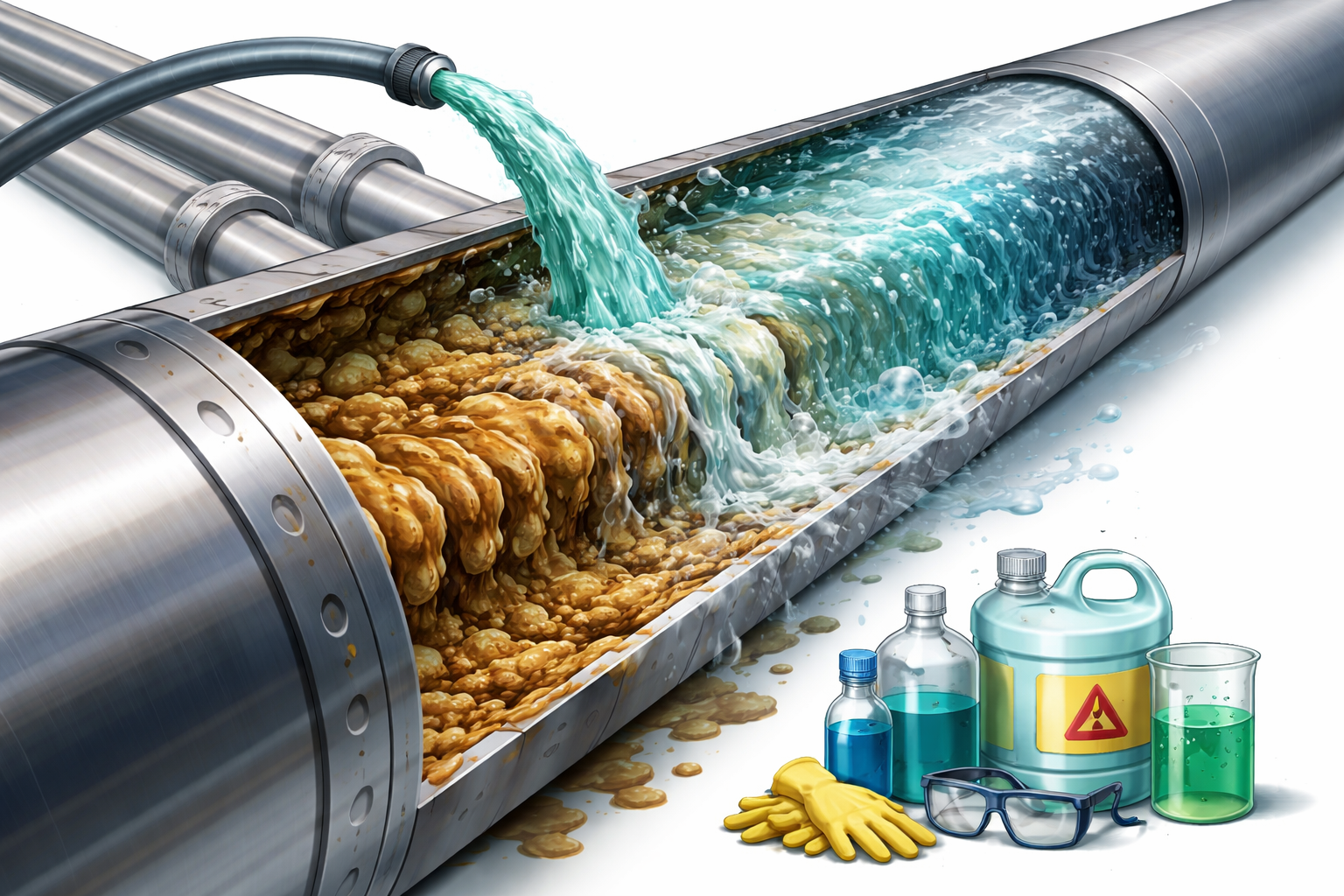
Acid cleaning is one of the most effective methods for restoring equipment performance by removing mineral scale and certain fouling deposits. When applied correctly, it extends equipment life and improves operational efficiency.
Purpose of acid cleaning and descaling
The primary goal is to dissolve and remove deposits that cannot be eliminated through mechanical or physical methods, restoring original heat transfer and flow characteristics.
How acids remove scale and fouling deposits
Acids react chemically with alkaline mineral deposits, converting insoluble salts into soluble compounds that can be flushed from the system. Some acids also help loosen organic and mixed deposits.
Risks associated with improper acid use
Incorrect acid selection, excessive concentration, or prolonged exposure can attack base metals, damage welds, and compromise protective oxide layers.
Importance of compatibility with metallurgy
Each alloy responds differently to acids. Compatibility with carbon steel, stainless steel, copper alloys, or specialty metals must be evaluated before cleaning.
Types of Acids Used for Industrial Descaling
Selecting the right acid requires balancing cleaning efficiency with material safety, environmental considerations, and operational constraints.
Hydrochloric acid (HCl): effectiveness and risks
Hydrochloric acid is highly effective against calcium carbonate and iron oxides. Its fast reaction rate makes it popular, but it is also aggressive, especially toward carbon steel, and requires strong inhibitors to limit corrosion.
Sulfuric acid: applications and limitations
Sulfuric acid is effective for certain carbonate scales but can form insoluble calcium sulfate, potentially worsening fouling. Its use is limited by this risk and its high corrosivity at elevated temperatures.
Organic acids (citric, formic, acetic)
Organic acids offer gentler cleaning with lower corrosion rates. Citric acid is effective against iron-based deposits, while formic and acetic acids are used where metallurgical sensitivity is a concern.
Sulfamic acid: balanced performance
Sulfamic acid provides a balance between effectiveness and safety. It dissolves carbonate scale efficiently while being less volatile and easier to handle than mineral acids.
Blended and inhibited acids
Custom blends combine acids with corrosion inhibitors, surfactants, and dispersants to improve performance while protecting equipment surfaces.
How Acid Selection Impacts Equipment Life
Acid choice directly influences corrosion behavior, cleaning effectiveness, and long-term asset integrity.
Corrosion rates and metal loss
Aggressive acids increase corrosion rates, leading to measurable metal loss during each cleaning cycle.
Effect on carbon steel vs stainless steel
Carbon steel is particularly vulnerable to mineral acids, while stainless steel may suffer from pitting or stress corrosion cracking under certain conditions.
Role of corrosion inhibitors
Inhibitors form protective films that significantly reduce metal attack, making them essential in industrial acid cleaning.
Overcleaning vs undercleaning risks
Excessive cleaning accelerates wear, while insufficient cleaning leaves deposits that continue to cause damage.
Acid strength, temperature, and exposure time
Higher temperatures and longer exposure increase reaction rates, but also corrosion risks, requiring careful control.
Best Practices for Acid Selection in Industrial Systems
A systematic approach to acid selection minimizes risk and maximizes equipment longevity.
Matching acid type to scale composition
Deposit analysis ensures the chosen acid targets the actual scale chemistry.
Evaluating metallurgy and system design
Material compatibility, weld quality, and flow geometry must all be considered.
Importance of lab testing and pilot trials
Small-scale testing validates effectiveness and corrosion behavior before full implementation.
Compliance with safety and environmental standards
Proper handling, neutralization, and disposal are critical for regulatory compliance.
Working with chemical treatment experts
Experienced suppliers help optimize formulations and procedures for specific systems.
Preventive Strategies to Minimize Scaling and Fouling
While cleaning is necessary, prevention remains the most cost-effective strategy.
Water treatment and conditioning
Softening, demineralization, and pH control reduce scaling potential.
Use of anti-scalants and dispersants
These additives inhibit crystal growth and keep particulates suspended.
Regular monitoring and inspection
Early detection prevents severe buildup and aggressive cleaning cycles.
Predictive maintenance approaches
Data-driven maintenance schedules reduce unplanned downtime and asset stress.
Case Example: Acid Selection and Equipment Longevity
Problem overview
A plate heat exchanger experienced recurring fouling and frequent acid cleaning, leading to thinning plates and leaks.
Acid selection approach
Deposit analysis revealed mixed carbonate and iron oxide scale. A switch from uninhibited hydrochloric acid to an inhibited sulfamic–organic acid blend was implemented.
Results and lessons learned
Cleaning effectiveness improved, corrosion rates dropped significantly, and equipment service life was extended—demonstrating the value of informed acid selection.
FAQs – Scaling, Fouling, and Acid Cleaning
How often should industrial systems be acid cleaned?
Frequency depends on water quality, process conditions, and monitoring data, but overcleaning should be avoided.
Can acid cleaning damage equipment?
Yes, if improperly selected or applied without inhibitors and controls.
What is the safest acid for descaling?
Safer options include inhibited sulfamic or organic acids, depending on scale type.
How do inhibitors protect equipment?
They reduce metal dissolution by forming temporary protective layers on surfaces.
Are there eco-friendly acid alternatives?
Yes, biodegradable organic acids and low-toxicity blends are increasingly used.
Conclusion: Choosing the Right Acid for Long-Term Equipment Health
Scaling and fouling are unavoidable in many industrial systems, but their impact on equipment life is largely controllable. Acid cleaning remains a powerful tool, but only when applied with a clear understanding of deposit chemistry, metallurgy, and corrosion behavior.
Informed acid selection reduces metal loss, prevents premature failures, and lowers long-term operating costs. By combining proper analysis, testing, and expert guidance, operators can transform chemical cleaning from a reactive necessity into a strategic asset that supports reliability, safety, and sustained performance.