Chemical Purity vs. Process Yield: Where Small Impurities Cause Big Losses
Introduction – The Hidden Cost of “Minor” Impurities
In many chemical processes, purity is treated as a specification box to be checked rather than a core economic variable. As long as a material meets the minimum stated grade, small deviations are often dismissed as operational noise - too minor to justify tighter controls or higher sourcing costs. In reality, these “minor” impurities frequently represent hidden expenses that quietly erode process efficiency, consistency, and profitability.
A common misconception is that
higher purity inevitably comes at the expense of throughput. Operators may assume that accepting slightly lower purity enables faster production, higher yields, or reduced costs. This perceived trade-off, however, is often false. In practice, impurities introduce variability that disrupts reaction kinetics, fouls catalysts, increases side reactions, and complicates downstream separation. The result is not higher productivity, but unplanned downtime, reprocessing and material losses.
What makes trace impurities particularly dangerous is their ability to cascade through an entire process. A few parts per million of an unwanted ion or organic residue can reduce conversion efficiency, degrade product quality, or trigger compliance failures further down the line. Over time, these small chemical imperfections translate into disproportionately large yield losses, turning “acceptable” purity into a costly compromise.
Understanding Chemical Purity in Industrial Processes
What Is Chemical Purity?
Chemical purity describes the proportion of a desired substance relative to all other components present in a material. While the concept sounds straightforward, its practical meaning differs significantly between laboratory and industrial contexts. In laboratory settings, purity is often pursued as an absolute (99.9% or higher) primarily to ensure reproducibility and analytical accuracy. Industrial processes, by contrast, define purity in relation to process tolerance, regulatory requirements, and economic feasibility. The key question is not whether impurities exist, but which impurities are present and at what levels they begin to affect performance.
Purity is typically expressed using several common metrics. Percentage purity (%) or assay indicates the mass or molar fraction of the main component and is widely used in commercial specifications. For high-sensitivity processes, impurities are measured in parts per million (ppm) or even parts per billion (ppb), particularly when trace metals, halides, or organic residues are involved. Importantly, two materials with the same assay can behave very differently if their impurity profiles differ - highlighting why total purity alone is often an incomplete indicator of process suitability.
Sources of Impurities
Impurities can enter a process from multiple points, often in ways that are not immediately visible in standard quality checks. One of the most common sources is raw material variability. Differences in upstream production methods, feedstock quality, or storage conditions can introduce fluctuating levels of trace contaminants that accumulate over time.
Catalyst degradation is another critical factor. As catalysts age, they may shed active metals, supports, or by-products into the reaction mixture. These contaminants
can poison the catalyst further, alter reaction pathways, or interfere with downstream purification steps.
Solvent contamination also plays a significant role, particularly in closed-loop or recycled solvent systems. Trace water, dissolved gases, or degradation products can build up gradually, shifting reaction equilibria or promoting unwanted side reactions.
Finally, equipment fouling and cross-contamination are often underestimated sources of impurities. Residues from previous campaigns, corrosion products, or insufficient cleaning between batches can introduce foreign species that persist far longer than expected. In tightly controlled industrial processes, these hidden impurity sources can be just as damaging as poor-quality raw materials - if not more so.
What Is Process Yield and Why It Matters
Defining Process Yield
Process yield is a measure of how efficiently a chemical process converts raw materials into the intended final product. In its simplest form, yield compares the actual amount of product obtained to the theoretical maximum predicted by stoichiometry and reaction design. Theoretical yield assumes ideal conditions - perfect conversion, no side reactions, and no losses. Actual yield reflects reality, incorporating the effects of impurities, incomplete reactions, mechanical losses, and operational variability.
In industrial manufacturing, yield is far more than a technical calculation; it is a core performance indicator. As a key performance indicator (KPI), yield is used to benchmark process efficiency, compare production campaigns, and evaluate the impact of raw material quality or process changes. Even small percentage changes in yield can signal underlying issues in reaction control, purification efficiency, or equipment condition, making yield one of the most sensitive indicators of process health.
Economic & Operational Importance
From an economic standpoint, process yield directly determines the cost per kilogram of product produced. Lower yields mean that more raw materials, energy, and processing time are required to achieve the same output. In high-volume or high-purity chemical production, this difference can translate into substantial cost increases that are often hidden within overall operating expenses.
Poor yield also drives secondary costs through waste generation, rework, and disposal. Off-spec material may require additional purification, blending, or complete disposal, each adding labor, energy, and compliance costs. In regulated industries, disposal of contaminated or unusable material can be particularly expensive due to environmental and safety requirements.
Beyond cost, yield has a growing impact on sustainability metrics. Lower yields increase material intensity, energy consumption, and waste per unit of product, negatively affecting carbon footprint and environmental performance indicators. As manufacturers face increasing pressure to meet sustainability and ESG targets, improving process yield is no longer just an efficiency goal; it is a strategic lever for reducing environmental impact while maintaining profitability.
How Small Impurities Lead to Big Yield Losses
Reaction Kinetics Disruption
Even at very low concentrations, impurities can significantly disrupt reaction kinetics. Many industrial reactions are finely balanced systems where temperature, concentration, and catalyst activity are optimized for a narrow operating window. When impurities are introduced, they may participate in side reactions, alter reaction pathways, or interfere with active sites on catalysts. The result is reduced selectivity toward the desired product and a higher proportion of by-products.
This selectivity loss is often more damaging than incomplete conversion. While unreacted raw material can sometimes be recovered or recycled, side products frequently cannot. They consume valuable reactants, complicate downstream processing, and may degrade product quality. Over time, what appears to be a marginal impurity level can systematically divert a meaningful fraction of input material away from the target reaction, lowering overall yield with every batch.
Catalyst Poisoning
Catalyst poisoning is one of the most direct and costly ways impurities reduce yield. Trace levels of metals, sulfur compounds, or halides (often present at ppm or even ppb levels) can irreversibly bind to active catalytic sites. Once poisoned, the catalyst’s activity and selectivity decline, requiring higher temperatures, longer residence times, or increased catalyst loading to maintain output.
The economic impact extends beyond immediate yield loss. Reduced catalyst life increases replacement frequency, raises operating costs, and introduces variability between production campaigns. In continuous processes, gradual poisoning can go unnoticed until yields have already fallen significantly, making it difficult to trace the root cause back to a seemingly insignificant impurity in the feedstock or solvent.
Downstream Separation Challenges
Impurities rarely stop causing problems once the reaction step is complete. In downstream separation, even small changes in composition can dramatically affect efficiency. Additionally, by-products or closely boiling impurities can make distillation more complex, requiring higher reflux ratios, more stages, or longer operating times to achieve specification.
These adjustments increase energy consumption and reduce throughput, further lowering effective yield. In some cases, separation becomes economically unfeasible, resulting in off-spec batches that must be downgraded or discarded. The yield loss is then not only chemical but also operational, as production capacity is consumed without generating a sellable product.
Case Example (Conceptual)
Consider a process designed to operate with a raw material purity of 99.9%. Introducing an impurity at a level below 0.1% may appear negligible on paper. However, if that impurity promotes a side reaction consuming just 5–10% of the main reactant, the theoretical yield immediately drops. Add partial catalyst poisoning and more difficult separation, and the total yield loss can easily reach 5–15%.
What makes this scenario particularly costly is that no single failure point is obvious. Each step appears only slightly less efficient, yet the combined effect compounds across the process. This is why small impurities so often cause big yield losses - and why purity decisions should be evaluated across the entire process, not just against a specification sheet.
The Purity–Yield Trade-Off Myth
“Higher Purity Costs More” – Is It True?
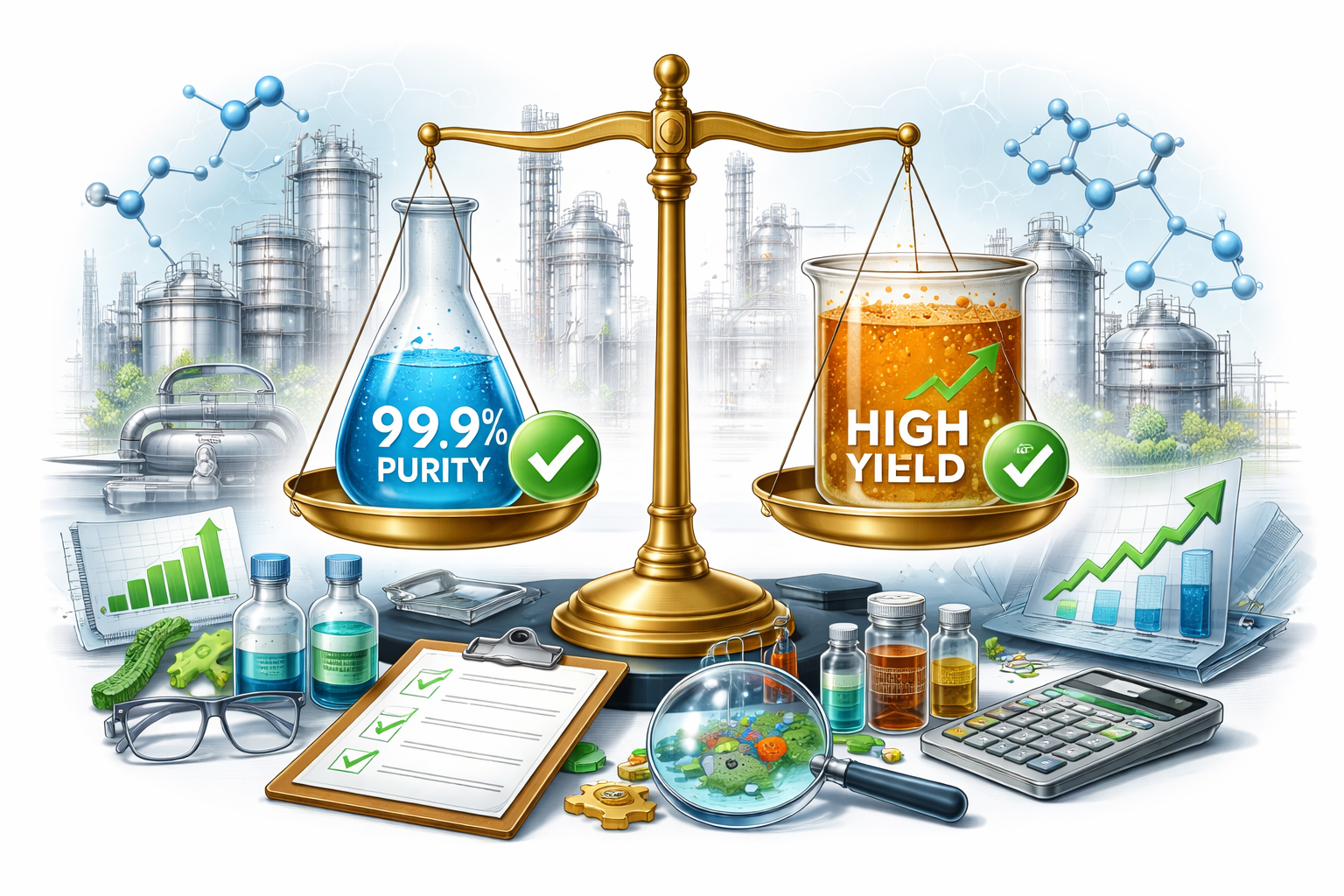
A common assumption in chemical manufacturing is that achieving higher purity always comes at a prohibitive cost, forcing operators to accept lower purity to maximize throughput. While it is true that some purification steps - extra filtration, distillation, or reagent refinement - require additional resources, evaluating cost solely in the short term can be misleading. When impurities cause yield losses, increased waste, or catalyst degradation, the downstream costs quickly outweigh the initial savings from using lower-purity materials. A holistic, long-term analysis often reveals that investing in higher-purity inputs or tighter quality control improves overall process economics, not just product quality. Essentially, small upfront costs can prevent disproportionately larger losses later, turning “expensive” purity into a cost-saving strategy.
When Over-Purification Hurts
Conversely, pursuing absolute purity beyond process requirements can also be inefficient. Over-purification introduces diminishing returns: removing trace contaminants that have no measurable impact on reaction performance consumes energy, labor, and time without meaningful benefit. Additional processing steps may also increase complexity, require more equipment, and introduce opportunities for contamination or operational error. The key is balance - understanding which impurities matter, at what level, and how they affect the specific process. By targeting critical impurities rather than maximizing purity indiscriminately, manufacturers can protect yield, maintain operational efficiency, and optimize costs.
In short, the notion that purity and yield are inherently at odds is a myth. Properly managed, higher-purity inputs and precise impurity control enhance both yield and profitability, while indiscriminate over-purification wastes resources without tangible gain.
Strategies to Balance Chemical Purity and Process Yield
Raw Material Qualification & Supplier Control
The foundation of balancing purity and yield starts with raw materials. Even trace impurities in feedstocks can propagate through a process, reducing yield and increasing operational costs. Implementing a rigorous incoming quality control (QC) program is essential. This includes not only standard assay verification but also targeted impurity profiling using techniques such as ICP-MS for metals, GC-MS for organics, or titration for specific ions.
Supplier control is equally important. Working closely with trusted suppliers to define clear specifications, impurity limits, and acceptable variability can prevent quality issues before they enter the plant. Periodic audits, sample testing, and long-term partnerships help ensure consistency, reducing the likelihood of surprises that can disrupt process performance.
In-Process Monitoring
Once materials enter production, real-time monitoring is critical to maintain both yield and product quality. Process Analytical Technology (PAT) tools - including spectroscopy, chromatography, and online sensors - allow continuous tracking of reaction parameters and impurity levels.
By monitoring impurities in real time, operators can detect deviations early, adjust process conditions, or divert material before it impacts downstream steps. This proactive approach prevents small problems from escalating into significant yield losses and provides data to refine process control strategies.
Process Optimization Techniques
Advanced process optimization techniques help define the optimal balance between purity and yield. Design of Experiments (DoE) is widely used to systematically explore how variables - temperature, pH, residence time, and reactant ratios - affect both conversion and impurity formation. These studies identify the conditions that maximize yield without allowing impurities to compromise product quality.
Impurity tolerance mapping complements this approach by quantifying how much of a given contaminant can be present before it negatively affects the process. By understanding these thresholds, manufacturers can make informed decisions about when additional purification is necessary and when it is economically unnecessary.
Smart Purification Approaches
Not all purification steps need to be applied universally. Targeted purification focuses on removing only the critical impurities that affect yield, reaction selectivity, or compliance, rather than attempting blanket purification of every contaminant. This approach reduces energy consumption, processing time, and operational complexity while maintaining high overall yield and quality.
By combining careful raw material control, real-time monitoring, optimized reaction conditions, and intelligent purification strategies, manufacturers can achieve the ideal equilibrium: high product yield without compromising purity, cost efficiency, or sustainability. This integrated mindset transforms purity from a perceived expense into a strategic advantage for modern chemical production.
Industry-Specific Impacts
Pharmaceuticals
In the pharmaceutical industry, even minute impurities can have disproportionate consequences. Regulatory authorities such as the FDA and EMA enforce strict limits on both active pharmaceutical ingredients (APIs) and residual impurities. Minor deviations from purity standards can trigger batch rejection, costly reprocessing, or complete disposal. Beyond financial losses, failed batches can disrupt supply chains and delay product availability, directly affecting patient access and company reputation. For high-value APIs, a small impurity that slightly reduces yield can translate into significant economic and operational setbacks, making rigorous purity control indispensable.
Specialty Chemicals
Specialty chemical manufacturers face a different, but equally critical, purity–yield challenge. Customer specifications often demand precise chemical performance, whether in adhesives, coatings, or electronic materials. Trace contaminants can alter color, reactivity, or stability, resulting in products that fail to meet technical requirements. Even if the overall yield appears acceptable, non-conforming batches can lead to returns, warranty claims, or lost contracts. Here, purity is not just a chemical metric - it is a quality and performance determinant that directly affects customer satisfaction and market competitiveness.
Petrochemicals & Polymers
Large-scale petrochemical and polymer processes amplify the effects of impurities due to their high-volume, continuous nature. Catalysts used in cracking, polymerization, or reforming reactions are particularly sensitive to trace metals, sulfur, or halides. Minor contamination can reduce catalyst activity, shorten operational cycles, and lower overall throughput. At scale, these impacts are magnified: small deviations in purity can result in significant material losses, higher energy consumption, and increased downtime for catalyst replacement or system cleaning. Maintaining consistent feedstock purity is therefore essential for maximizing yield and operational efficiency in these capital-intensive processes.
Across industries, the common thread is clear: even low-level impurities can cascade into major yield and quality losses. Understanding the specific sensitivity of each sector helps manufacturers prioritize which impurities to monitor and control, allowing them to protect both process efficiency and product integrity.
FAQs – Chemical Purity vs Process Yield
What impurity level is acceptable in industrial processes?
Acceptable impurity levels vary depending on the chemical, process, and industry requirements. Some high-volume petrochemical processes tolerate ppm-level impurities, while pharmaceuticals and specialty chemicals often require sub-ppm control. The key is understanding which impurities impact reactions, catalysts, or product quality, rather than focusing solely on total purity.
Can higher purity ever reduce yield?
Yes, but only in cases of over-purification. Removing non-critical trace components beyond what the process can tolerate may add extra processing steps, energy consumption, or handling losses without improving product performance. Smart, targeted purification maximizes yield while eliminating only impurities that matter.
How do you identify yield loss caused by impurities?
Yield loss from impurities can be detected through careful monitoring of process KPIs, reaction selectivity, and product quality. Analytical tools such as chromatography, spectroscopy, or metal analysis help link impurity levels to deviations in conversion or by-product formation. Comparing batches with different raw material purity or impurity profiles often reveals the impact on yield.
Is impurity control more important than throughput?
Impurity control and throughput are interconnected rather than mutually exclusive. Poor impurity management can reduce effective throughput due to side reactions, off-spec batches, or equipment fouling. Conversely, prioritizing throughput at the expense of purity may increase overall costs and waste. The optimal approach balances both, targeting critical impurities while maintaining efficient production rates.
Proper impurity management protects both yield and product quality, turning what might seem like minor deviations into major economic and operational advantages.
Conclusion – Optimizing What Truly Matters
Purity and yield are often framed as opposing priorities, but in reality, they are mutually reinforcing when managed strategically. High-purity inputs, coupled with careful impurity control, do not automatically reduce throughput; instead, they prevent side reactions, catalyst degradation, and downstream inefficiencies that silently erode yield. Understanding this relationship allows manufacturers to see purity not as a cost, but as a key lever for improving overall process performance.
Small impurity decisions, whether in raw material selection, in-process monitoring, or purification strategy, can have outsized financial consequences. A trace contaminant at the ppm level may seem negligible, yet it can trigger multi-percent yield losses, increase energy usage, and create off-spec batches. Conversely, intelligently targeted purity control protects both yield and product quality, reducing waste, energy consumption, and operational risk.
For process leaders, the takeaway is clear: focus on the impurities that truly matter, monitor them continuously, and optimize processes holistically. By treating purity and yield as complementary rather than conflicting objectives, companies can unlock both economic and operational benefits, transforming small chemical details into significant strategic advantages.