Heavy Metals in Industrial Chemicals: Why Trace Contamination Matters
Walk into almost any manufacturing facility, whether it produces pharmaceuticals, plastics, textiles or electronics, and you'll find a supply chain built on industrial chemicals: catalysts, solvents, raw materials, reagents and processing aids. Most quality conversations about these chemicals focus on purity in the obvious sense, does the product meet its stated specification, is it free of unwanted byproducts, does it perform as expected? But there's a quieter, less visible risk that has become one of the most consequential issues in chemical manufacturing over the past two decades: trace heavy metal contamination.
Heavy metals like lead, cadmium, mercury, arsenic, chromium, and nickel rarely show up in industrial chemicals as intentional ingredients. They arrive as hitchhikers, residues from catalysts, impurities in raw ore-derived materials, contaminants from processing equipment, or byproducts of the manufacturing process itself. Individually, the quantities involved are often minuscule, measured in parts per million or even parts per billion. Yet these trace amounts carry outsized consequences for human health, environmental safety, regulatory compliance, and brand reputation. Understanding why such small quantities matter so much is essential for anyone working in chemical manufacturing, quality assurance, procurement, or product safety.
What Counts as a "Heavy Metal," and Why This Group Is Different
The term "heavy metal" is used loosely in industry and regulation; it doesn't map cleanly onto a single scientific definition based on atomic density or weight. In practice, the term refers to a group of metallic elements that are toxic at relatively low exposure levels and tend to persist in biological and environmental systems. The metals of greatest concern in industrial chemistry typically include lead, mercury, cadmium, arsenic, chromium (particularly hexavalent chromium), nickel, and sometimes cobalt, antimony, and thallium.
What sets these elements apart from many other contaminants is a combination of three properties. First, they are not biodegradable. Unlike organic contaminants that microorganisms or environmental processes can break down over time, heavy metals are elements; they don't degrade. Once released into soil, water, or living tissue, they remain until they are physically removed or chemically transformed into a different compound, which does not eliminate the underlying toxicity of the metal itself.
Second, many heavy metals bioaccumulate. Organisms absorb them more readily than they excrete them, so concentrations build up over time in tissues, particularly in fat, bone, liver, and kidney. This accumulation means that even exposure levels considered "safe" for a single incident can become dangerous when repeated over months or years, and it explains why heavy metals biomagnify up food chains - predators accumulate higher concentrations than their prey.
Third, heavy metals are toxic through mechanisms that don't have a true "safe" threshold in the way some other substances do. Lead, for instance, interferes with enzyme systems and neurological development at levels once considered harmless; decades of research have progressively lowered the blood lead level considered acceptable in children, and many toxicologists now argue no level is truly without risk. This is fundamentally different from substances where the body has robust detoxification pathways and a genuine margin of safety exists.
How Heavy Metals End Up in Industrial Chemicals
Trace heavy metal contamination in industrial chemicals is rarely intentional, but it is also rarely accidental in the sense of being a one-off event. It typically stems from a handful of predictable sources built into the chemistry and logistics of manufacturing.
Catalysts are one of the most significant sources. Many industrial chemical reactions, particularly in pharmaceutical synthesis, polymer production, and petrochemical refining, rely on metal catalysts to speed up reactions or improve yield. Palladium, platinum, nickel, and other metals are common catalysts, and residual amounts can remain in the final product if purification steps aren't rigorous enough. Even catalysts based on "benign" metals can carry trace impurities of more toxic ones, since industrial-grade metal sources are rarely 100% pure.
Raw materials derived from mined ores are another major pathway. Many industrial chemicals originate from minerals extracted from the earth, and ore bodies naturally contain a mixture of elements. Processing limestone into lime, phosphate rock into fertilizer components, or metal ores into salts and oxides can carry along trace levels of whatever else was present in the original deposit—often arsenic, cadmium, or lead, depending on the geology of the source region.
Processing equipment contributes as well. Reactors, pipes, and storage vessels are frequently made of metal alloys, and even well-maintained equipment can shed trace amounts of metal into chemicals that pass through it, especially under conditions of high heat, pressure, or corrosive chemistry. This is particularly relevant for chemicals that are acidic, oxidizing, or otherwise reactive toward the equipment surfaces they contact.
Recycled or secondary raw materials add another layer of risk. As industries increasingly incorporate recycled plastics, reclaimed solvents, or secondary metal sources into their supply chains for sustainability reasons, they also inherit whatever contamination history those materials carry. A recycled plastic feedstock, for example, may carry trace heavy metal residues from pigments, stabilizers, or previous applications that are difficult to fully characterize or remove.
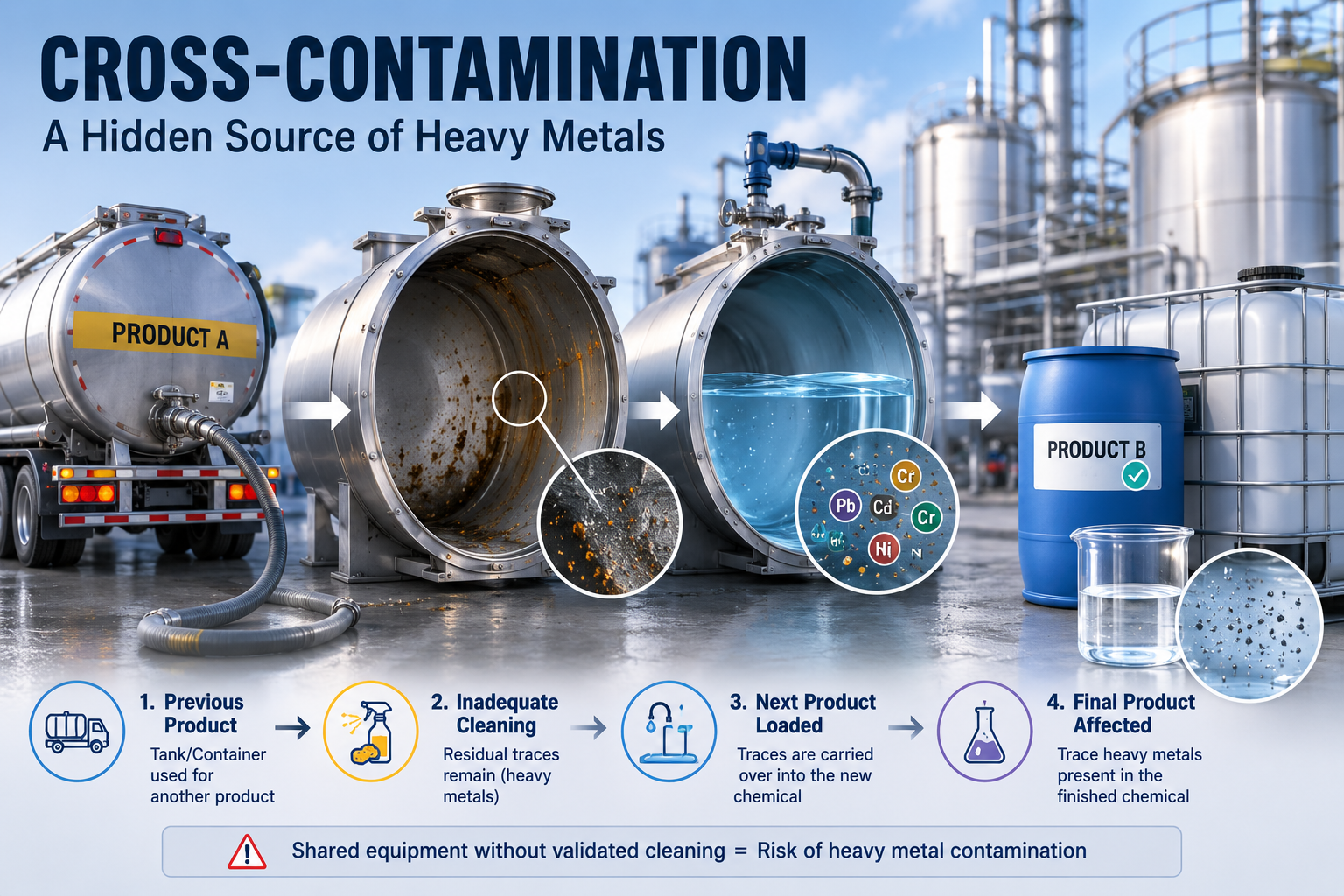
Finally, cross-contamination during transport and storage can introduce heavy metals into otherwise clean chemicals, particularly when shared equipment, tanks, or containers are used across different product lines without adequate cleaning validation.
Why Trace Levels Still Matter
It's tempting to assume that if a contaminant is present only in parts per million or parts per billion, it must be negligible. This assumption breaks down for several reasons specific to heavy metals.
The first is the cumulative exposure problem. An individual chemical product might contain only a trace amount of lead or cadmium, but that chemical is often just one ingredient in a much larger downstream product - a plastic component, a pharmaceutical excipient, a food-contact coating, a piece of consumer electronics. When multiple ingredients each contribute their own small trace contamination, the final product can carry a meaningfully higher total burden than any single input would suggest. This is especially concerning for products used repeatedly or over long periods, such as medications taken daily or food packaging used across a person's lifetime.
The second reason is that heavy metal toxicity often doesn't follow a simple dose-response curve with a clear safe threshold. Regulatory toxicologists increasingly work with the concept that for certain heavy metals, particularly lead, there may be no exposure level below which effects, especially neurodevelopmental effects in children are completely absent. This has driven regulatory limits progressively lower over time as scientific understanding has improved, rather than settling on a stable "safe" number.
Third, industrial chemicals often serve as inputs across enormous production volumes. A contamination level that seems trivial in a single batch can translate into a substantial aggregate quantity of heavy metal entering commerce, the environment, and human exposure pathways when that chemical is used across thousands of tons of downstream production. A few parts per million of cadmium in a widely used pigment or stabilizer, multiplied across a global supply chain, represents a very different scale of concern than the same concentration in a niche specialty product.
Fourth, vulnerable populations experience disproportionate risk from trace exposures that might be inconsequential for a healthy adult. Children absorb lead more efficiently than adults and are more susceptible to its neurological effects. Pregnant women can pass heavy metal exposure to a developing fetus, where the consequences can be permanent. Workers with chronic, repeated occupational exposure to trace contaminants face cumulative risks that consumers using a product occasionally do not.
The Regulatory Response
Regulators worldwide have responded to these realities by tightening permissible limits on heavy metals in industrial chemicals and the products derived from them, and by shifting the burden of proof toward manufacturers to demonstrate safety rather than waiting for evidence of harm.
In the pharmaceutical sector, the International Council for Harmonisation's ICH Q3D guideline established a risk-based framework requiring manufacturers to assess and control elemental impurities across drug products, setting permitted daily exposure limits for numerous metals based on their route of administration and toxicity profile. This guideline reshaped how pharmaceutical companies evaluate raw materials, catalysts, and packaging components throughout their supply chains.
In the European Union, the REACH regulation (Registration, Evaluation, Authorisation and Restriction of Chemicals) requires manufacturers and importers to register chemical substances and assess their hazards, including heavy metal content, with restrictions applying to substances of very high concern. The EU's RoHS directive similarly restricts heavy metals like lead, mercury, cadmium, and hexavalent chromium in electrical and electronic equipment.
In the United States, the Environmental Protection Agency regulates heavy metal discharge and contamination through frameworks including the Toxic Substances Control Act and various water quality standards, while the Food and Drug Administration has increasingly focused on heavy metal contamination in food, supplements, and pharmaceutical excipients following high-profile contamination incidents.
These regulatory frameworks share a common thread: they treat heavy metal contamination not as a simple pass/fail specification issue, but as a risk to be actively characterized, monitored, and minimized throughout a product's lifecycle - from raw material sourcing through manufacturing, use, and disposal.
Detection and Mitigation
Addressing trace heavy metal contamination starts with analytical capability. Modern instrumentation such as inductively coupled plasma mass spectrometry (ICP-MS) can detect heavy metals at parts-per-trillion sensitivity, allowing manufacturers to characterize contamination levels far below what was measurable a generation ago. This analytical progress has, in some ways, driven the regulatory tightening—once you can reliably detect a contaminant at very low levels, it becomes possible to set and enforce correspondingly strict limits.
Beyond detection, manufacturers rely on several mitigation strategies. Supplier qualification programs assess raw material sources for heavy metal risk before they enter the supply chain, particularly for materials derived from mining or recycling streams. Purification processes, including chelation, filtration, and recrystallization, can be optimized specifically to strip residual metal catalysts from finished chemical products. Equipment material selection increasingly favors metal alloys and linings that minimize leaching into sensitive product streams. And robust batch-testing programs, informed by risk assessments that identify which raw materials and process steps carry the highest contamination risk, allow companies to catch problems before contaminated material reaches customers.
A Problem That Rewards Vigilance, Not Complacency
The core lesson from decades of heavy metal contamination incidents - from lead in gasoline and paint to cadmium in fertilizers to mercury in industrial effluent - is that trace contamination problems tend to be underestimated until their cumulative consequences become undeniable. Heavy metals don't announce themselves the way an acute chemical hazard does. There's no immediate reaction, no obvious sensory warning, no dramatic failure. The harm accumulates quietly, in tissues and ecosystems, over years or decades, often becoming visible only after significant damage has occurred.
This is precisely why trace-level heavy metal management deserves serious, sustained attention rather than treatment as a minor compliance checkbox. For chemical manufacturers, this means building rigorous testing and supplier qualification into standard operating procedure, not just responding to regulatory minimums. For downstream industries that purchase industrial chemicals as inputs, it means understanding the heavy metal risk profile of every supplier and material in the chain, since a contamination problem several tiers upstream can surface in a finished consumer product. And for regulators and researchers, it means continuing to refine the scientific understanding of low-dose, chronic heavy metal exposure, since the picture has consistently moved toward stricter limits as evidence has accumulated.
Trace contamination might be measured in parts per million, but its consequences are measured in the health of workers, consumers, and ecosystems over a much longer timescale. That's why, even in an industry accustomed to managing far larger and more visible hazards, heavy metals in industrial chemicals remain a problem worth taking seriously down to the smallest detectable trace.