From Lab Sample to Full-Scale Production: The Hidden Risks of Changing Chemical Suppliers
A new supplier sends over a sample. The certificate of analysis looks clean, the price is 12% lower, and your chemist runs a bench-scale test that works beautifully. Procurement is happy, R&D is happy, and the switch looks like an easy win.
Then the first production batch arrives. Yields drop, filtration takes twice as long, a coating starts to haze, or a formulation that was stable for two years separates after three weeks on the shelf. Suddenly the "savings" are being eaten by rework, scrapped batches and emergency meetings.
This scenario plays out across the chemical, pharmaceutical, coatings, plastics, food ingredient, and electronics industries every year. The reason is rarely that the new supplier is "bad." It's that a laboratory sample and a full-scale commercial supply are two very different things, and the gap between them is where the hidden risks live.
This article looks at why those gaps exist, what risks they create, and how to qualify a new chemical supplier without betting your production line on a single small sample.
Why a Good Sample Doesn't Guarantee a Good Supply
A sample is a snapshot. It shows what one supplier can deliver on one occasion, often in a small quantity, sometimes hand-selected from their best material. It tells you little about how that supplier performs across dozens of batches, multiple raw material lots, different seasons and varying production conditions.
Several things can make a sample unrepresentative:
- Cherry-picked material. Some suppliers send their best retained sample, or material from a carefully controlled pilot run, to win the business.
- Different production route. Samples may come from a laboratory or pilot-scale process, while commercial volumes are made in large reactors with different heat transfer, mixing, and purification behavior.
- Single-batch data. One batch cannot reveal variability. Statistical confidence requires multiple lots.
The first hidden risk, then, is a mindset problem: treating a successful sample as proof of a successful supplier.
Risk 1: Different Impurity Profiles
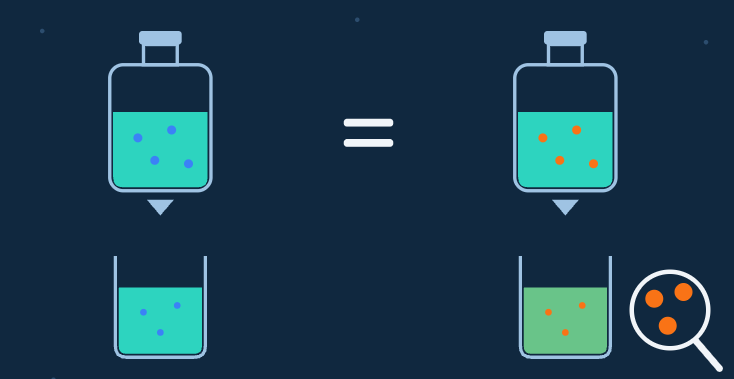
Two products can share the same name, CAS number, and headline purity of 99% and still behave completely differently. The difference is in the remaining 1%.
Different manufacturers use different synthetic routes, catalysts, solvents, and purification methods. Each route leaves its own fingerprint of by-products, residual solvents, trace metals, and isomers. Your existing process may have quietly adapted to your incumbent supplier's impurity profile, or even depend on it.
Consider a few examples of how trace components cause problems:
- Trace metals can poison catalysts, discolor polymers, or accelerate oxidation in sensitive formulations.
- Residual acids or bases can shift pH and affect reaction rates, emulsion stability, or corrosion.
- Unknown organic impurities may inhibit a polymerization or show up as extra peaks in your final product's analysis.
- Water content varies widely and can ruin moisture-sensitive reactions.
A standard certificate of analysis usually reports only a limited set of parameters. The impurities that matter to your process may not be listed at all. That's why a "meets specification" result is not the same as "performs identically."
Risk 2: Physical Properties the Spec Sheet Doesn't Capture
Chemical identity is only part of the picture. Physical form often determines whether a material works in practice, and it's one of the most common sources of unpleasant surprises during scale-up.
Properties that frequently differ between suppliers include:
- Particle size and distribution, which affects dissolution rate, dispersion, reactivity, and flowability.
- Crystal form (polymorphism), which influences solubility, stability, and bioavailability, a critical concern in pharmaceuticals.
- Bulk density and flow behavior, which determine how a powder feeds through hoppers and dosing equipment.
- Morphology and surface area, which matter enormously for pigments, fillers, catalysts, and battery materials.
- Viscosity and rheology for liquids and polymer solutions, which can differ even when the nominal grade is the same.
A powder that dissolves in 30 seconds in a flask may clump and take ten minutes in a 5,000-liter tank. A grade that flows smoothly in a lab funnel can bridge and jam in a full-scale feeder. These issues rarely appear at small scale, which is exactly why they're expensive when discovered late.
Risk 3: Batch-to-Batch Variability
Consistency matters more than any single result. A supplier with slightly lower average quality but tight control may be far better for your process than one with excellent averages and wide swings.
Variability comes from many places: raw material changes upstream, differences between production campaigns, aging equipment, operator practices, and how strictly the supplier's quality system is enforced. A supplier who sends you one impressive sample has told you nothing about their process capability.
When evaluating a new source, look at data across many batches, not just one. If a supplier can provide historical control charts or capability indices for critical parameters, that's a strong signal of process maturity. Reluctance to share any batch history is a signal too.
Risk 4: Additives, Stabilizers, and "Undeclared" Differences
Many chemical products contain small amounts of stabilizers, inhibitors, anti-caking agents, or processing aids. These are sometimes considered proprietary and may not appear on a basic data sheet.
Changing suppliers can therefore change your formulation without anyone realizing it. A different inhibitor level in a monomer can alter cure time. A different anti-caking agent in a salt can affect solution clarity. A different stabilizer in a solvent can change shelf life or interfere with downstream reactions.
Ask directly what additives are present, at what levels, and whether they're consistent across production. If the answer is vague, treat that as a risk to be tested, not assumed away.
Risk 5: Packaging, Storage, and Stability
Even a chemically identical product can degrade differently depending on how it's packaged, transported, and stored.
- Container materials can leach, absorb moisture, or allow oxygen ingress.
- Headspace and inerting practices affect oxidation-sensitive products.
- Drum liners, seals, and closures vary in quality and can create contamination or leakage risks.
- Shipping routes and climate exposure matter, especially for temperature-sensitive materials moving across regions or through summer heat and winter cold.
A product that stays stable for a year when packed one way may show discoloration or reduced potency in six months when packed another. Stability data from the new supplier's actual packaging, under realistic shipping conditions, is far more useful than theoretical shelf-life claims.
Risk 6: Regulatory and Documentation Gaps
For regulated industries, changing a supplier is not just a technical decision. It can trigger formal obligations.
In pharmaceuticals, changing the source of an active ingredient or key excipient often requires change control, comparability studies, and in some cases regulatory notification or approval. In food, cosmetics, and medical devices, changes may require updated safety documentation, allergen statements, and traceability records. In chemicals more broadly, you need to confirm registration status under frameworks such as REACH in Europe or TSCA in the United States, as well as up-to-date safety data sheets.
Common documentation problems include:
- Missing or outdated safety data sheets
- Unclear regulatory status for your target markets
- Incomplete traceability from raw material to finished lot
- Certifications (such as ISO 9001, GMP, or Kosher/Halal) that don't cover the specific production site making your product
Also confirm which facility will make your material. Some suppliers quote from one plant and ship from another, and the qualification you reviewed may not apply.
Risk 7: Supply Chain Fragility
A supplier who can send a 5 kg sample may not be able to deliver 50 tons reliably. Capacity, raw material sourcing, and logistics all matter once you move to commercial volumes.
Questions worth asking include:
- Do they manufacture the product themselves, or are they a trader or distributor sourcing from someone else?
- What is their actual production capacity, and how much of it would your volume represent?
- Do they depend on a single raw material source or a single plant?
- What are typical lead times, and how do they perform during demand spikes or disruptions?
- What happens if one production line goes down?
A trader may offer attractive pricing but have little visibility into, or control over, the actual manufacturing process. If the underlying manufacturer changes without notice, so does your product, and you may be the last to know.
Risk 8: The Scale-Up Effect
Even when material quality is identical, behavior at scale is not the same as behavior in the lab. Heat transfer, mixing efficiency, addition rates, and residence times all change as volumes grow. A small difference in a raw material's reactivity or impurity content that is invisible in a 500 mL flask can be amplified in a 10,000-liter reactor.
This is why qualification should not stop at bench trials. Pilot-scale or plant trials with the new material, using your actual equipment and process conditions, expose problems that lab work cannot. Skipping this step to save time is one of the most common and costly shortcuts in supplier changes.
Risk 9: The True Cost Is Not the Price Per Kilogram
A lower unit price can be misleading. The total cost of a supplier change includes:
- Qualification testing and analytical work
- Pilot and plant trial time and materials
- Potential yield loss or increased rework
- Additional incoming inspection and testing
- Regulatory and documentation effort
- Risk of production downtime or customer complaints
- Management and engineering time
A supplier switch that saves 10% on material cost can easily lose money if it reduces yield by 3% or causes a single rejected production run. Procurement teams that evaluate suppliers on price alone often discover this the hard way. Cross-functional evaluation involving R&D, quality, production, and regulatory teams leads to better decisions.
How to Qualify a New Supplier the Right Way
None of this means you should never change suppliers. Competition, resilience, and cost pressure are all legitimate reasons to diversify. The goal is to switch deliberately, with evidence, rather than on the strength of a single sample.
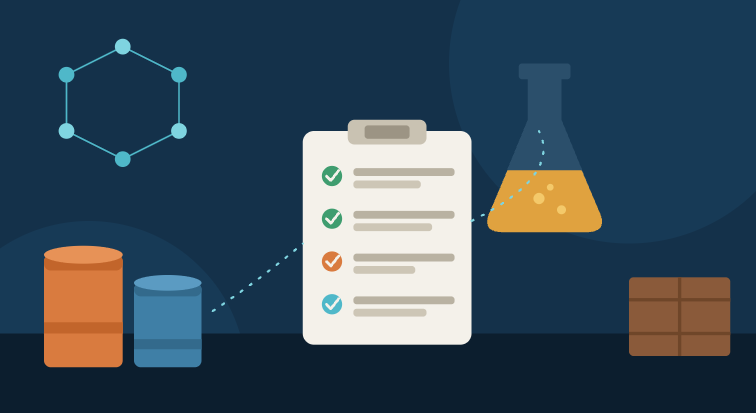
1. Define what actually matters. Before testing anything, identify the critical quality attributes for your process and product. Go beyond the standard specification to include impurities, physical properties, and performance in your application.
2. Request comprehensive data. Ask for full certificates of analysis from multiple batches, impurity profiles, stability data, safety documentation, and regulatory statements. Be specific about what you need beyond the standard sheet.
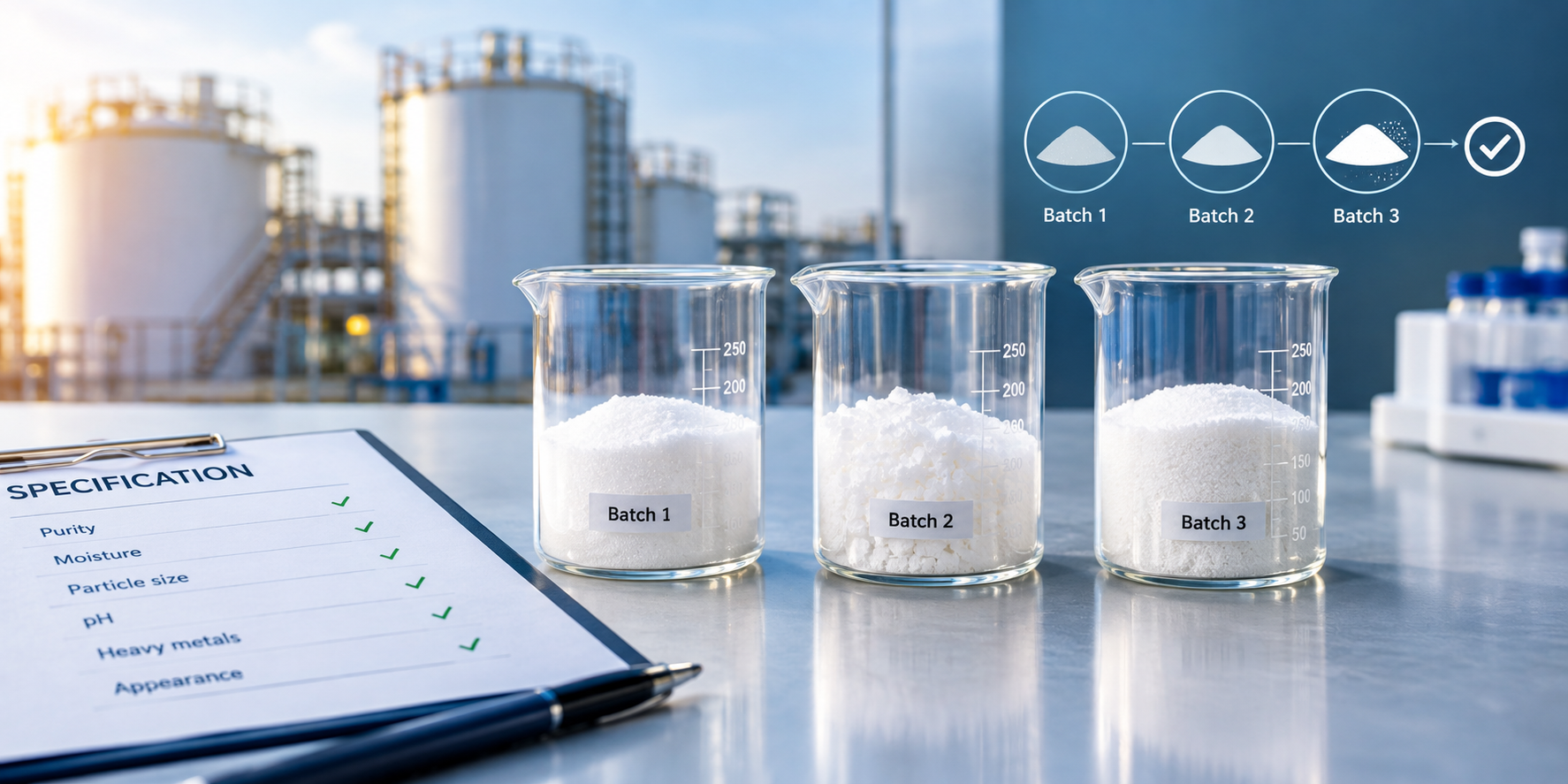
3. Test multiple lots. Evaluate at least three separate production batches, ideally made at different times. This is the only way to see real variability.
4. Compare head-to-head. Run the new material alongside your current supplier's product under identical conditions, using analytical methods that go beyond the basic specification.
5. Scale up in stages. Move from bench to pilot to plant trials, watching for behavior that changes with volume, especially in mixing, filtration, drying, and handling.
6. Audit the supplier. Where possible, review their quality system, visit the manufacturing site, or at minimum conduct a detailed questionnaire and document review. Confirm who actually makes the product and where.
7. Agree on change control. Include contractual requirements that the supplier will notify you before altering raw materials, processes, sites, or packaging. Unannounced changes are among the most damaging risks in any supply relationship.
8. Keep a fallback. Maintain your qualified incumbent supplier, or a second qualified source, until the new supplier has proven consistent over a meaningful period. Dual sourcing costs a little in efficiency but protects against a lot of downside.
9. Monitor after the switch. Track incoming quality, process performance, and customer feedback closely after the change. Early detection of drift is far cheaper than late detection.
A Practical Checklist
Before approving a supplier change, confirm that you can answer "yes" to the following:
- Have we tested more than one production lot?
- Do we understand the impurity profile and how it differs from the current material?
- Have we compared physical properties, not just chemical purity?
- Have we run pilot or plant trials at relevant scale?
- Is the manufacturing site clearly identified and certified?
- Are regulatory, safety, and traceability documents complete and current?
- Is there a change notification agreement in place?
- Do we have a fallback source during the transition?
- Have R&D, quality, production, procurement, and regulatory all signed off?
If any of these is a "no," the risk is probably higher than the price sheet suggests.
Final Thoughts
The move from lab sample to full-scale production is where assumptions get tested and shortcuts get exposed. A sample that performs well is a promising start, but it is only the first data point in a much longer evaluation.
The hidden risks of changing chemical suppliers, including impurity differences, physical property variation, batch inconsistency, undisclosed additives, packaging effects, regulatory gaps, supply chain fragility, and scale-up behavior, are not reasons to avoid change. They are reasons to manage it with discipline. Companies that invest in thorough qualification, clear communication with suppliers, and structured change control tend to gain the benefits of new sources without the painful surprises.
In chemical manufacturing, the cheapest material is rarely the one with the lowest price. It is the one that runs consistently, meets specification every time, and never makes the news for the wrong reasons.