When Chemical Specifications Don't Tell the Whole Story: Understanding Product Consistency Between Batches
You order the same product from the same supplier, with the same part number and a certificate of analysis that shows every parameter comfortably within specification. Yet on the production floor, something is off. The coating dries more slowly. The reaction yield drops by a few percent. The powder clumps in the hopper, or the formulation separates after a week on the shelf. The lab confirms that the new batch "meets spec." So why doesn't it behave like the last one?
If you have worked with industrial chemicals, raw materials, or ingredients for any length of time, you have probably lived some version of this story. It is one of the most frustrating problems in process manufacturing, and it comes from a simple truth: a specification sheet describes what was measured, not everything that matters.
This article explains why batches that are chemically "identical" on paper can perform differently, which hidden variables most often cause trouble, and what buyers, formulators and quality teams can do to protect their processes.
What a Specification Actually Is
A specification is an agreement. It lists a set of properties, each with an acceptable range, that a supplier commits to deliver and that a buyer agrees to accept. Typical entries include assay or purity, moisture content, density, pH, color, and limits on a handful of known impurities.
Specifications are essential. They make commerce possible, allow suppliers and customers to speak a common language, and provide a legal and technical baseline when something goes wrong. But they have three built-in limitations.
First, they are finite. A product might be described by eight or ten parameters, yet the material itself has hundreds of measurable characteristics. Only a few were selected for the spec, usually because they were historically important, easy to measure, or demanded by a regulation.
Second, they are ranges, not points. A purity specification of "min. 98.0%" accepts material at 98.1% and at 99.8% alike. Both are compliant, but they are not the same material. The remaining 1.9% in one case and 0.2% in the other may consist of entirely different compounds.
Third, they reflect the past. Specifications are usually written around the application the product was first sold for. If your use differs, or has become more demanding over time, the original parameters may no longer capture what drives performance in your process.
In short, a specification tells you that a material falls within a defined envelope. It does not promise that everything inside the envelope behaves identically.
The Hidden Variables Behind Batch-to-Batch Variation
When two compliant batches behave differently, the cause almost always sits in a property that is not on the certificate. Here are the most common culprits.
1. The Impurity Profile, Not Just the Impurity Total
Purity is typically reported as a single number: the percentage of the main component. But the remainder matters enormously, and what it contains can change from batch to batch.
Consider two lots of the same solvent, both at 99.5% purity. In one, the remaining 0.5% is mostly water. In the other, it is a mixture of closely related organic by-products. The assay is identical, but the second lot might poison a catalyst, shift a boiling range, or alter the odor of a finished product.
Trace impurities are especially significant. Parts-per-million levels of a metal ion can accelerate degradation, discolor a polymer, or interfere with a sensitive reaction. If your specification only restricts "total heavy metals," a harmless metal and a highly reactive one look exactly the same.
2. Physical Form and Particle Characteristics
For solids, chemical composition is only half the story. Particle size distribution, particle shape, surface area, bulk density and porosity all influence how a material dissolves, flows, mixes and reacts.
Two batches of the same pigment may have identical chemical analysis but different particle size distributions. The finer batch will give stronger color, higher viscosity in a dispersion and a different feel in the final product. Two batches of an active ingredient may dissolve at noticeably different rates, which can affect everything from reaction kinetics to the bioavailability of a pharmaceutical.
Crystalline materials add another layer. Many compounds can exist in more than one crystal form, known as polymorphs, each with different solubility, stability and melting behavior. A change in crystallization conditions at the supplier's plant can produce a different polymorph or a different ratio of forms, with no change at all in chemical purity.
3. Moisture and Its History
Moisture content often appears on a specification, but the number alone can mislead. How water is held in a material matters as much as how much there is. Surface moisture, bound water and hydrates behave differently. A powder that was dried aggressively and then re-exposed to humid air may show the same moisture percentage as one that was gently dried, yet it can cake, cluster or react differently.
Moisture also changes after the certificate was issued. Material analyzed at the supplier's plant in dry conditions can pick up water during shipping and storage, so the batch you open may not match the batch they tested.
4. Raw Material Sources and Process Changes Upstream
Your supplier has suppliers. Natural-origin materials are the clearest example: plant extracts, minerals, oils, gums and fermentation products vary with harvest season, geography, weather and processing. But synthetic chemicals are affected too. A producer might switch a feedstock supplier, change a catalyst, adjust a reactor temperature profile, or move production to another site. Each of these can quietly alter the impurity profile or physical form while the product still passes every release test.
Some suppliers notify customers of significant process changes; many do not, particularly when the change is considered minor or when the product is a commodity. By the time you notice, the new behavior has often been in your plant for several batches.
5. Stabilizers, Additives and Processing Aids
Many commercial chemicals contain small amounts of stabilizers, inhibitors, anti-caking agents or residual processing aids. These may be considered proprietary and may not appear in the specification at all. A change in the type or level of an inhibitor can alter shelf life, reactivity and storage behavior. A different anti-caking agent can change how a powder behaves in a blend.
6. Aging and Storage Effects
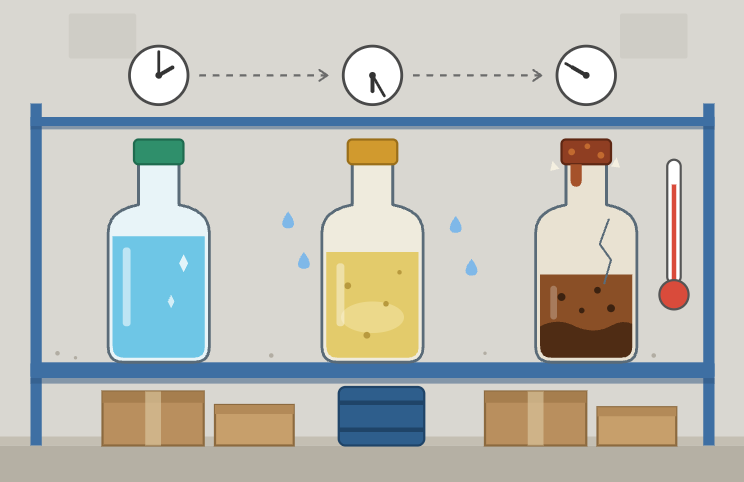
Chemicals are not static. Oxidation, hydrolysis, polymerization, light exposure and temperature cycling all change materials over time. A product that was within specification when it left the factory may have drifted by the time it reaches your process, and two batches of different age, or stored under different conditions, will not be equivalent even if they began identically.
Why Standard Quality Control Misses These Differences
Quality control is designed to confirm compliance with the specification. It is not designed to find everything that could possibly differ. That distinction explains why problems slip through.
Routine release testing at the supplier measures the listed parameters on a sample, typically from a single point in a batch. If the batch is not perfectly homogeneous, that sample may not represent the material in every drum. At the customer's end, incoming inspection often repeats a subset of the same tests, which means it inherits the same blind spots.
There is also the matter of measurement itself. Every analytical method has uncertainty, and different laboratories using different methods or equipment can report slightly different values for the same material. When a result sits near a specification limit, such differences may decide whether a batch passes or fails, even though the underlying material is unchanged.
Finally, specifications are mostly static tests applied to dynamic processes. A material is measured at rest, under controlled conditions. Your process stresses it with heat, shear, solvents, time pressure and interactions with other ingredients. Performance under those conditions is what matters, and it can only be seen by testing under them.
Signs You May Have a Consistency Problem
Batch variation rarely announces itself clearly. Watch for these patterns:
- Intermittent quality issues that cannot be traced to equipment, operators or other inputs.
- Process adjustments that operators make "by feel" for certain lots, such as extending mixing time or tweaking temperature.
- Differences in appearance, odor, flow or handling between batches that nonetheless pass inspection.
- Shifts in yield, cycle time or defect rate that correlate with a change in lot number.
- Finished-product complaints that cluster around specific production dates.
If your team has started informally ranking batches as "good" or "bad", that is a strong signal. It means the specification is not capturing what your process actually needs.
How to Protect Your Process
The good news is that batch variation can be managed. The approach combines better information, better testing and better relationships.
Define What Actually Matters to Your Application
Start from performance rather than from the supplier's datasheet. Identify which material properties drive success in your process: viscosity, dissolution rate, color, reactivity, shelf life, flow. Then work backwards to determine how those properties can be measured. This exercise often reveals critical parameters that were never on any specification.
Add Application-Specific Tests
A functional test, meaning a small-scale version of your real process, is often the most reliable way to qualify a batch. Mix a lab-scale sample, cure a test panel, run a bench reaction, or measure dissolution under your conditions. These tests directly measure what you care about, and they catch differences that chemical analysis cannot.
Keep Retention Samples and a Reference Standard
Keep a sealed sample of every received batch, and designate a "golden" batch that performed well. When a new lot arrives, compare it directly against the reference using the same methods on the same day. Relative comparison is far more sensitive than checking absolute numbers against a range, and retention samples allow you to investigate problems retrospectively.
Track Data Over Time
Record results for each batch and look at trends rather than only at pass or fail. A parameter that stays within range but slowly drifts toward a limit is an early warning. Simple control charts can reveal shifts that no single result would expose, and correlating process outcomes with incoming material data can point to the variable that truly matters.
Request More Than the Standard Certificate
Ask suppliers for additional information: impurity profiles, particle size data, polymorph information, raw material origin and details of the manufacturing site. Many suppliers hold this data and will share it under confidentiality, particularly with customers who explain why they need it. For critical materials, consider a quality agreement that defines tighter or additional parameters and requires advance notice of process changes.
Build a Genuine Supplier Relationship
Treat key suppliers as technical partners. Visit their facilities if possible, share your application requirements, and report problems with detailed data rather than general complaints. Suppliers who understand how their product is used are more likely to flag changes proactively and to help solve problems when they occur. Where practical, qualify a second source, which not only secures supply but also provides a useful point of comparison.
Build Tolerance into the Process
Alongside controlling inputs, make your own process more robust. Where feasible, include adjustment steps, such as in-process checks and correction points, so that normal variation in raw materials can be compensated rather than passed through to the final product.
What Suppliers Can Do
This is not only a buyer's problem. Suppliers benefit from consistency too, because complaints, returns and lost customers are expensive. Producers who want to be trusted for the long term can:
- Understand their customers' applications, not just their purchase specifications.
- Control and document raw material sources and process parameters tightly.
- Communicate changes in advance, even ones considered minor.
- Provide extended analytical data on request.
- Monitor customer feedback and treat complaints as technical information, not as disputes to be won on the basis of the specification.
The suppliers customers value most tend to be the ones who say, "Our product meets the spec, but let's find out why it isn't working for you."
A Practical Example
Imagine a manufacturer of water-based paints that buys a thickening polymer. For two years, the product performs flawlessly. Then, over a few months, operators begin reporting that batches are taking longer to build viscosity. The thickener's certificates are unchanged: viscosity, pH and solids content are all within range.
After weeks of investigation, the team runs a side-by-side test of the current lot and a retained sample of an older one. The new lot hydrates more slowly. Further analysis shows a slightly coarser particle size, caused by a change in the supplier's drying process. Particle size was never on the specification, and it never occurred to anyone to ask for it.
The fix is straightforward: add a particle size parameter to the agreement, introduce a simple viscosity-build test on incoming lots, and ask the supplier for notification of drying process changes. The cost is minimal compared with the weeks of lost productivity, yet the problem could have been prevented from the start with a better understanding of what the specification did and did not cover.
Key Takeaways
A specification is a useful but incomplete description of a chemical product. Two batches can both comply and still differ in impurity profile, particle characteristics, physical form, moisture history, additives and age, and any of these can change how a material behaves in your process.
The remedy is not to distrust specifications, but to understand their limits. Define what matters for your application, test for it directly, keep reference samples, watch trends, and work with suppliers as partners. The goal is to move from asking "does it meet spec?" to asking "will it perform?" Those are different questions, and in manufacturing, only the second one pays the bills.