Chemical Shelf Life: What Happens to Industrial Chemicals During Long-Term Storage?
Every industrial chemical, no matter how stable it appears on the day it leaves the manufacturing plant, is engaged in a slow and continuous chemical conversation with its environment. Heat, light, moisture, oxygen, container materials, and even the passage of time itself all leave their mark. For facility managers, chemists, and procurement teams, understanding what actually happens inside a drum, tote, or storage tank during months or years of storage is not an academic exercise — it directly affects product performance, worker safety, regulatory compliance, and the bottom line. This article examines the mechanisms behind chemical degradation, the warning signs of an expired or compromised product, and the practical steps organizations can take to extend usable shelf life.
Why "Shelf Life" Is Not an Arbitrary Number
Manufacturers assign shelf-life or expiration dates based on stability testing, which typically involves storing a chemical under controlled and accelerated conditions and measuring how its properties change over time. These dates are conservative estimates built around a simple question: at what point can the manufacturer no longer guarantee that the product will perform as specified?
It's tempting to think of a shelf-life date the way many people think of a "sell by" date on food — a soft suggestion rather than a hard rule. For some low-reactivity substances, that assumption is roughly correct. But for reactive chemicals, catalysts, polymers, and formulated products, the date reflects real underlying chemistry. A stabilizer additive may deplete at a predictable rate. A catalyst's active sites may slowly lose activity through sintering or poisoning. An adhesive's cross-linking agents may react prematurely inside the container. In each case, the expiration date marks the point at which the manufacturer's testing data stops covering the product's behavior — not necessarily the exact moment the chemical becomes unusable, but the point past which nobody can vouch for it.
The Core Degradation Mechanisms
Although every chemical family has its own quirks, most long-term storage problems trace back to a handful of underlying mechanisms.
Oxidation
Exposure to atmospheric oxygen is one of the most pervasive causes of chemical degradation. Unsaturated organic compounds, oils, fuels, and many polymers are particularly vulnerable. Oxidation reactions can proceed slowly at room temperature but accelerate sharply with rising temperature, light exposure, or the presence of trace metal contaminants that act as catalysts. The result may be discoloration, increased viscosity, the formation of peroxides, or a loss of the compound's original functional properties. Some organic peroxides formed this way are themselves unstable and can become a serious safety hazard, since peroxide accumulation in aging ethers and other organics is a well-documented cause of unexpected explosions during handling or distillation.
Hydrolysis
Many industrial chemicals — esters, amides, certain pesticides, and a wide range of specialty formulations — are susceptible to hydrolysis, a reaction with water that breaks chemical bonds and alters the molecule's structure. Even trace atmospheric humidity can drive this reaction over long storage periods, especially if a container is repeatedly opened and closed, allowing moist air to enter each time. Hydrolysis-sensitive materials often show subtle signs of trouble long before catastrophic failure: a slight change in odor, a drop in pH, or gradual clouding of a normally clear liquid.
Polymerization and Cross-Linking
Monomers, resins, and certain adhesives are formulated with inhibitors that prevent premature polymerization. Over time, these inhibitors deplete — through consumption in side reactions, evaporation, or simple chemical breakdown — leaving the material increasingly prone to spontaneous reaction. This is especially dangerous because polymerization reactions are often exothermic and self-accelerating: once they begin in a poorly ventilated or improperly stored container, the heat generated can push the reaction out of control, in some cases leading to violent container rupture.
Thermal Decomposition
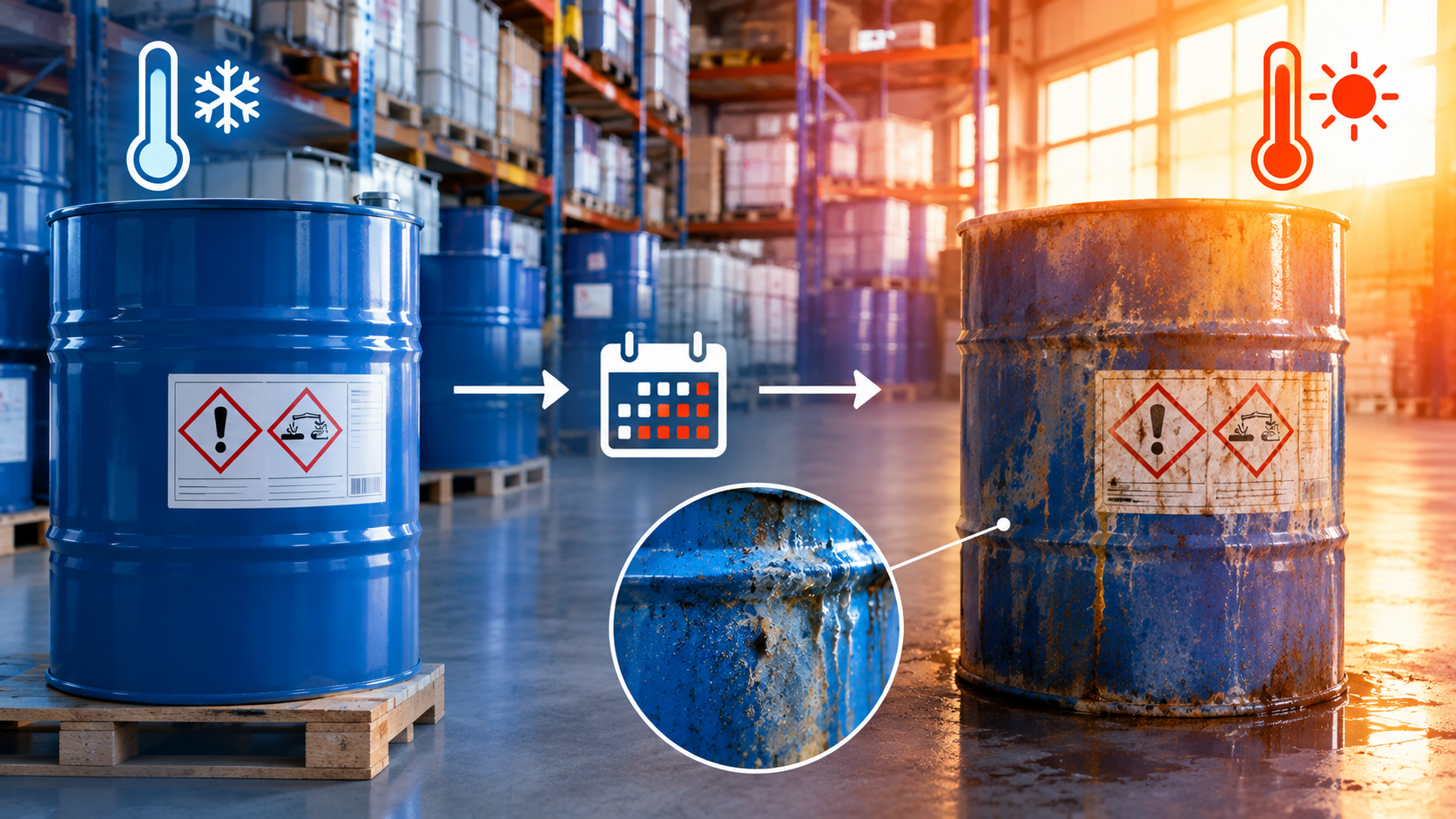
Even without oxygen or moisture, many chemicals slowly decompose simply due to ambient thermal energy. This is especially relevant for compounds with inherently unstable bonds — nitro compounds, certain peroxides, diazo compounds, and some pharmaceuticals and agrochemicals. Elevated storage temperatures, even those well below a compound's formal decomposition temperature, can meaningfully shorten shelf life. As a rule of thumb rooted in the Arrhenius relationship between temperature and reaction rate, many chemical degradation reactions roughly double in speed for every 10°C increase in storage temperature — which is why a warehouse that gets hot in summer can quietly erode years of expected shelf life in a matter of weeks.
Photodegradation
Ultraviolet and visible light can supply enough energy to break chemical bonds directly or to initiate radical chain reactions. Photosensitive chemicals — many dyes, certain agrochemicals, some pharmaceuticals, and light-sensitive photoinitiators — require opaque or amber packaging specifically to slow this process. Long-term storage in clear containers, or even repeated brief exposure during handling, can measurably shorten usable life.
Volatilization and Loss of Volatile Components
Formulated products often depend on a careful balance of components, some of which are more volatile than others. Solvents can evaporate through imperfect seals, gasket materials can degrade and allow slow leakage, and multi-component blends can separate as lighter fractions escape preferentially. The result is a product whose remaining composition no longer matches its label — sometimes with a more concentrated, more hazardous residue left behind.
Physical Changes: Crystallization, Sedimentation and Phase Separation
Not all degradation is strictly chemical. Physical changes can render a chemical unusable even when its molecular composition remains intact. Supersaturated solutions can crystallize out over time. Suspensions and emulsions can settle, cream, or separate into distinct phases. Some materials undergo polymorphic transitions, shifting between crystal forms with different solubility or reactivity profiles. These changes can sometimes be reversed with proper remixing or reheating, but in other cases, the physical transformation is effectively permanent.
Container and Packaging Interactions
The container is never a passive bystander. Chemicals can react with, permeate through, or corrode their packaging over extended storage periods, and packaging materials can, in turn, leach into the product.
Metal drums and totes can corrode from the inside, particularly when storing acidic, alkaline, or halogenated materials, introducing metal ions that may catalyze further degradation of the contents. Plastic containers are not immune either: certain solvents can slowly permeate polyethylene or polypropylene walls, gradually reducing product volume and concentration while also risking gasket and seal degradation. Some plastics leach plasticizers or stabilizers into their contents, subtly altering formulated products over time. Rubber and elastomeric seals are especially vulnerable to swelling, hardening, or chemical attack, and a compromised seal is often the entry point for the atmospheric oxygen or moisture that then drives the degradation reactions described above.
This is why proper container selection isn't a one-time decision made at the point of purchase — it's an ongoing part of a long-term storage strategy, requiring periodic inspection of drums, totes, and tanks for corrosion, seal integrity, and pressure buildup.
Warning Signs That a Chemical Has Degraded
Recognizing the physical and sensory signs of degradation is a critical, low-cost first line of defense, even before formal testing is performed. Common indicators include:
- Color change — darkening, yellowing, or the appearance of unexpected color that wasn't present in the fresh material
- Odor change — a sharper, sourer, rancid, or otherwise unfamiliar smell
- Viscosity change — a liquid that has thickened, thinned, or developed inconsistent texture
- Crystallization or precipitate — solids forming in a product that was originally a clear solution
- Container pressure buildup — bulging drums or hissing when a cap is loosened, which can indicate gas-generating decomposition
- Corrosion or staining on the container exterior — evidence of leakage or internal container attack
- Visible layering or separation in products meant to be homogeneous
None of these signs, on their own, definitively prove a chemical is unsafe or unusable, but any of them should trigger closer inspection, laboratory testing, or consultation with the manufacturer before the material is used or handled further.
Best Practices for Extending Shelf Life
While no storage practice can indefinitely suspend chemistry, several measures meaningfully slow degradation and reduce the risk of nasty surprises.
Control temperature. Because degradation rates so often scale with temperature, keeping storage areas cool and free of significant seasonal swings is one of the single most effective interventions available. Climate-controlled storage is a worthwhile investment for temperature-sensitive materials, even when the incremental cost seems hard to justify against a chemical's purchase price.
Limit light exposure. Store photosensitive materials in opaque containers, in windowless storage areas, or under amber lighting where appropriate.
Manage humidity. Moisture-sensitive materials benefit from desiccant packaging, nitrogen blanketing, or dedicated low-humidity storage rooms. Even brief exposure during transfer operations can matter for highly hygroscopic materials.
Minimize headspace and container openings. Every time a container is opened, fresh air — carrying oxygen and moisture — enters. Using appropriately sized containers, transferring to smaller vessels as stock is consumed, and using nitrogen purging for sensitive materials can all reduce this exposure.
Rotate stock using first-in, first-out (FIFO) principles. This sounds obvious, but in practice it's one of the most commonly neglected controls. Clear labeling with receipt dates, and periodic inventory audits, help ensure older stock is used before it exceeds its useful life.
Maintain container integrity. Regularly inspect drums, totes, and storage tanks for corrosion, seal degradation, and pressure changes. Replace aging gaskets proactively rather than reactively.
Verify inhibitor and stabilizer levels for reactive monomers. For materials prone to spontaneous polymerization, periodic testing of inhibitor concentration — not just visual inspection — is essential, since depletion isn't always visible until it's too late.
Consult Safety Data Sheets and manufacturer storage guidance. SDS documents typically specify recommended storage temperature ranges, incompatible materials, and container requirements. These aren't boilerplate language; they reflect real stability data.
Retest before use when in doubt. For high-value or safety-critical applications, periodic analytical retesting of long-stored material — checking purity, moisture content, pH, or other relevant specifications — can confirm whether a chemical remains fit for purpose, rather than relying solely on a printed expiration date.
The Regulatory and Safety Dimension
Beyond product performance, degraded chemicals can pose genuine safety and compliance risks. Peroxide-forming solvents that have aged past their recommended retest date are a well-known hazard in laboratories and industrial settings alike, with documented incidents of explosions during routine handling of old ether and similar compounds. Expired reactive monomers pose runaway polymerization risks. Degraded chemicals may also fall out of compliance with quality specifications required for regulated applications — pharmaceuticals, food-contact materials, or products subject to specific industry certifications — creating liability even when no acute safety incident occurs.
Proper hazardous waste characterization also becomes more complicated with aged or degraded chemicals, since the material's composition, and therefore its regulatory classification, may no longer match its original label. Organizations that store reactive or hazardous chemicals for extended periods should build periodic inspection and testing into their standard operating procedures, not treat it as an afterthought triggered only by a visible problem.
Conclusion
Chemical shelf life is not a bureaucratic formality — it's a reflection of ongoing chemistry that never fully stops, even inside a sealed container sitting quietly on a warehouse shelf. Oxidation, hydrolysis, polymerization, thermal decomposition, photodegradation, and physical changes all work continuously, at rates governed by temperature, light, moisture, and container quality. Understanding these mechanisms allows organizations to make smarter decisions about storage conditions, inventory rotation, and testing protocols, ultimately protecting both product quality and worker safety. Treating an expiration date as meaningful data rather than a suggestion, and building in periodic inspection and retesting for critical materials, is a modest investment that can prevent costly failures, wasted product, and genuine safety incidents down the line.