Chemical Samples Before Bulk Orders: Why Testing Matters
In the world of industrial procurement, few decisions carry as much weight as selecting a chemical supplier for a large-volume purchase. Whether you're sourcing raw materials for manufacturing, specialty additives for formulation, or industrial solvents for processing, the stakes of getting it wrong are high. A single batch of substandard or mismatched chemical material can derail production schedules, compromise product quality, trigger regulatory violations, and in the worst cases, create serious safety hazards.
This is why experienced procurement professionals and quality assurance teams insist on one non-negotiable step before committing to a bulk chemical order: sample testing. Requesting and thoroughly evaluating a sample before placing a large purchase order is not an optional formality — it is a critical risk-management practice that protects your operations, your finances, and your reputation.
This article explores why chemical sample testing matters, what it involves, the risks of skipping it, and how to build an effective sampling and testing process into your procurement workflow.
The High Cost of Skipping Sample Verification
When companies rush into bulk chemical purchases without proper sample verification, they expose themselves to a range of costly consequences.
Production disruptions. Chemicals that don't meet the expected specifications — whether in purity, concentration, particle size, or chemical composition — can cause equipment malfunctions, inconsistent reactions, or failed production runs. Reformulating a batch or halting a production line to address an unexpected material issue can cost far more than the price of the chemicals themselves.
Product quality failures. In industries like pharmaceuticals, cosmetics, food processing, and specialty manufacturing, even minor variations in raw material quality can alter the properties of the final product. A slight shift in pH, moisture content, or impurity profile can mean the difference between a product that performs as intended and one that fails quality control, requiring costly recalls or rework.
Regulatory and compliance risks. Many industries operate under strict regulatory frameworks — REACH in the European Union, TSCA in the United States, or various national pharmacopoeia standards — that require documented proof of material composition and purity. Using unverified bulk chemicals can result in compliance failures, fines, and in severe cases, suspension of manufacturing licenses.
Safety hazards. Some chemical discrepancies aren't just inconvenient — they're dangerous. Contaminated or mislabeled chemicals can react unpredictably, generate toxic byproducts, or pose fire and explosion risks. Testing samples in advance allows safety data to be verified and appropriate handling protocols to be established before large quantities enter your facility.
Financial loss. Perhaps the most direct consequence is financial. Bulk chemical orders often represent a significant capital outlay. If the received material turns out to be unusable, returning or disposing of it — especially hazardous materials — can be logistically complex and expensive. Disposal of unusable industrial chemicals often requires specialized handling, adding yet another layer of cost.
What Sample Testing Actually Verifies
Requesting a sample before a bulk order isn't just about "trying before you buy" in a casual sense. It's a structured verification process that typically examines several critical dimensions of the chemical product.
1. Purity and Composition
The most fundamental check is confirming that the chemical matches its stated purity level and composition. Techniques such as gas chromatography (GC), high-performance liquid chromatography (HPLC), mass spectrometry (MS), and Fourier-transform infrared spectroscopy (FTIR) are commonly used to identify the exact chemical makeup of a sample and detect any unexpected impurities or contaminants.
2. Physical Properties
Depending on the chemical, physical characteristics such as melting point, boiling point, density, viscosity, particle size distribution, and solubility can all affect how the material performs in your application. These properties should align closely with your technical specifications or datasheet requirements.
3. Consistency with Certificate of Analysis (CoA)
Reputable suppliers provide a Certificate of Analysis with each batch, listing test results for key parameters. Sample testing allows buyers to independently verify that the actual material matches what's documented in the CoA — an important check, since documentation errors or, in rare cases, intentional misrepresentation, can occur.
4. Performance in Application
Beyond laboratory analysis, many companies conduct application-specific testing — running the sample through the actual process it will be used in, whether that's a chemical reaction, a formulation, a coating application, or a manufacturing process. This step reveals real-world performance characteristics that pure lab analysis might miss, such as how a material behaves under specific temperature, pressure, or mixing conditions.
5. Stability and Shelf Life
Some chemicals degrade over time or under certain storage conditions. Testing a sample under simulated storage and transport conditions can reveal whether the material will remain stable and effective by the time it's actually used in production, especially important for bulk orders that may sit in inventory for weeks or months.
6. Batch-to-Batch Consistency
If you've worked with a supplier before, sample testing on a new shipment helps confirm that quality hasn't drifted from previous batches. Even reliable suppliers can experience variability due to changes in raw material sourcing, production conditions, or quality control lapses.
The Sample Testing Process: A Practical Framework
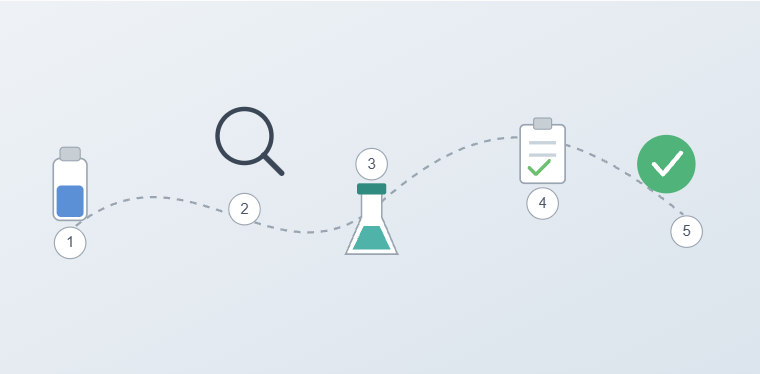
Effective chemical sample testing follows a structured approach. Here's how many procurement and QA teams organize the process.
Step 1: Define specifications clearly. Before requesting a sample, establish precise, written specifications for what you need — purity thresholds, acceptable impurity limits, physical property ranges, and any application-specific requirements. Vague specifications lead to ambiguous test results and disputes later.
Step 2: Request a representative sample. Ask suppliers for a sample drawn from the same batch or production process intended for the bulk order, not a specially prepared "showcase" sample. A representative sample gives a much more accurate picture of what you'll actually receive.
Step 3: Conduct in-house or third-party lab testing. Depending on your internal capabilities, testing can be performed in your own quality control lab or outsourced to an independent, accredited testing laboratory. Third-party testing is particularly valuable when working with new or overseas suppliers, as it removes any question of bias.
Step 4: Run application trials. Where feasible, test the sample in a small-scale version of its intended use. This might mean running a pilot batch, conducting a bench-scale reaction, or applying the material in a test formulation.
Step 5: Compare against specifications and CoA. Cross-reference your test results with both your internal specifications and the supplier's Certificate of Analysis. Flag and investigate any discrepancies before moving forward.
Step 6: Document everything. Keep thorough records of sample sources, test methods, results, and any communications with the supplier. This documentation is valuable not only for internal quality assurance but also for regulatory audits and, if necessary, for resolving disputes with suppliers.
Step 7: Make an informed decision. Only after this verification process should you proceed with a bulk order — and even then, consider starting with a smaller trial order before scaling to full volume, particularly with a new supplier relationship.
Building Strong Supplier Relationships Through Testing
Sample testing isn't just a defensive measure against bad actors — it's also a constructive part of building trust with legitimate, quality-focused suppliers. Reputable chemical suppliers generally welcome sample requests and testing, viewing it as a normal part of doing business and an opportunity to demonstrate the reliability of their product.
In fact, a supplier's willingness to provide representative samples, transparent documentation, and support for third-party testing is itself a useful signal of their credibility. Suppliers who resist reasonable sample requests, provide only limited quantities that make thorough testing difficult, or push back against independent verification should raise a flag for further scrutiny.
Over time, consistent sample testing also helps buyers build a data-driven picture of supplier performance. Tracking test results across multiple orders and suppliers allows procurement teams to identify which vendors reliably meet specifications and which show troubling patterns of variability — information that's invaluable when negotiating contracts or making long-term sourcing decisions.
Special Considerations for International and New Suppliers
The importance of sample testing increases significantly when dealing with new suppliers, and especially with international suppliers where in-person facility visits or long-standing relationships may not yet exist.
Language and specification barriers. Miscommunication about technical specifications is more likely when working across languages and different regulatory or industry standards. Sample testing helps catch these gaps before they become expensive problems.
Variable regulatory standards. Chemical quality and safety standards differ across countries. A supplier's local certification may not align with the standards required in your target market, making independent testing essential for compliance.
Logistics and degradation risks. International shipments often involve longer transit times and more variable storage conditions. Testing a sample after it has undergone similar shipping conditions can reveal whether the material is likely to arrive in acceptable condition at bulk-order scale.
Fraud and misrepresentation risks. Unfortunately, the global chemical trade has seen cases of counterfeit products, diluted materials, or mislabeled substances entering supply chains. Independent sample testing is one of the most effective safeguards against these risks.
Common Mistakes to Avoid
Even companies that recognize the value of sample testing can undermine the process through a few common missteps:
- Testing an unrepresentative sample. A sample that isn't drawn from the actual production batch or process intended for your order won't give you an accurate picture of what you'll receive.
- Skipping application testing. Lab analysis alone doesn't always predict how a material will behave in your specific process. Where possible, always complement lab testing with practical trials.
- Rushing the process to meet deadlines. Under time pressure, teams sometimes cut corners on testing. This is precisely when problems are most likely to slip through.
- Failing to retest with subsequent orders. Testing the first sample from a supplier but assuming all future batches will match is a common and risky oversight. Batch-to-batch verification, even if less extensive than initial testing, helps catch quality drift.
- Not documenting the process. Without clear records, it becomes difficult to hold suppliers accountable or to learn from past experiences when making future sourcing decisions.
Conclusion
Sample testing before bulk chemical orders is a small investment of time and resources that pays enormous dividends in risk reduction. It protects production continuity, product quality, regulatory compliance, workplace safety, and financial resources — all of which can be jeopardized by a single bad batch of raw material entering your supply chain unchecked.
In an increasingly global and complex chemical supply landscape, the discipline of "test before you commit" isn't just good practice — it's an essential safeguard. Companies that build rigorous, well-documented sample testing into their procurement process not only avoid costly mistakes but also strengthen their relationships with high-quality suppliers and build a more resilient, reliable supply chain over the long term.
The bottom line is simple: the modest cost and time investment of thorough sample testing is negligible compared to the potential losses from an unverified bulk chemical order gone wrong. For any organization serious about quality, safety, and operational reliability, sample testing isn't a step to skip — it's a step to master.