Potassium Nitrate Beyond Fertilizers: Energy Storage, Glass and Pyrotechnics
When most people hear potassium nitrate, they think of one thing - fertilizer. And for good reason, as a source of both nitrogen and potassium, two of the three macronutrients essential to plant growth, potassium nitrate (KNO₃), also known as saltpeter, has fed crops for centuries. But limiting this compound to the world of agriculture sells it short. Potassium nitrate is a remarkably versatile industrial chemical, and its footprint extends into some surprising corners of modern technology — from the molten salt tanks that store solar energy overnight, to the furnaces that toughen the glass in your smartphone, to the colorful fireworks that light up New Year's Eve skies.
This post takes a tour through three lesser-known but industrially significant applications of potassium nitrate, exploring the chemistry that makes each one possible.
A Quick Refresher on the Chemistry
Potassium nitrate is a white, crystalline salt made up of a potassium cation (K⁺) and a nitrate anion (NO₃⁻). It's naturally water-soluble, non-hygroscopic (it doesn't readily absorb moisture from the air, unlike some other nitrate salts), and thermally stable up to fairly high temperatures before it decomposes. It also happens to be a strong oxidizer, meaning it can readily give up oxygen to support combustion or other oxidation reactions.
These properties — thermal stability, oxidizing power, and a relatively low melting point compared to many other salts — are exactly why potassium nitrate shows up in such a wide range of industrial contexts beyond the farm.
Energy Storage: The Molten Salt Revolution
One of the most exciting modern applications of potassium nitrate is in thermal energy storage, particularly for concentrated solar power (CSP) plants.
The Problem CSP Plants Face
Solar power has an obvious limitation: the sun doesn't shine at night. Photovoltaic panels solve this indirectly through batteries, but concentrated solar power plants — which use mirrors to focus sunlight and generate heat rather than converting light directly to electricity — have a more elegant solution available to them: store the heat itself.
Enter Molten Salt
This is where potassium nitrate comes in. Many CSP plants use a mixture of molten salts as a heat transfer and storage medium, and one of the most common formulations is "solar salt," typically composed of about 60% sodium nitrate and 40% potassium nitrate by weight. This eutectic-like mixture melts at a lower temperature than either pure salt would on its own, while still remaining stable and pumpable at operating temperatures that can reach 565°C (roughly 1,050°F) or higher.
Here's how it works in practice at a typical CSP facility:
- During the day, an array of mirrors (heliostats) concentrates sunlight onto a central receiver, heating the molten salt mixture to a high temperature.
- The hot salt is pumped into a large insulated storage tank, where it can retain its heat for many hours with relatively little loss.
- When electricity is needed — including after sunset — the hot salt is circulated through a heat exchanger, generating steam that drives a conventional turbine and generator.
- The now-cooler salt returns to a "cold" storage tank, ready to be reheated the next day.
This two-tank system allows CSP plants to deliver dispatchable power on demand, smoothing out the inherent intermittency of solar energy. Some of the largest CSP installations in the world, including plants in Spain, Morocco, and the southwestern United States, rely on nitrate salt storage to extend their generating capacity well past sunset — in some cases providing 10 or more hours of storage.
Why Potassium Nitrate Specifically?
Sodium nitrate alone is cheaper, but blending it with potassium nitrate lowers the mixture's melting point, which reduces the risk of the salt solidifying in pipes and improves the overall thermal cycling behavior of the system. Potassium nitrate's chemical stability at high temperatures — it doesn't decompose significantly until temperatures well above typical CSP operating ranges — makes it a durable choice for a technology that needs to survive tens of thousands of heating and cooling cycles over a plant's operational lifetime.
Researchers continue to investigate other salt blends, including ternary mixtures with calcium or lithium nitrates, to push operating temperatures even higher and improve efficiency. But the sodium-potassium nitrate blend remains the industry workhorse due to its balance of cost, performance, and decades of operational track record.
Glass Manufacturing: Strength Through Chemistry
If you've ever owned a smartphone with "chemically strengthened" glass, you have likely benefited from potassium nitrate — just not in the way you might expect.
The Ion Exchange Process
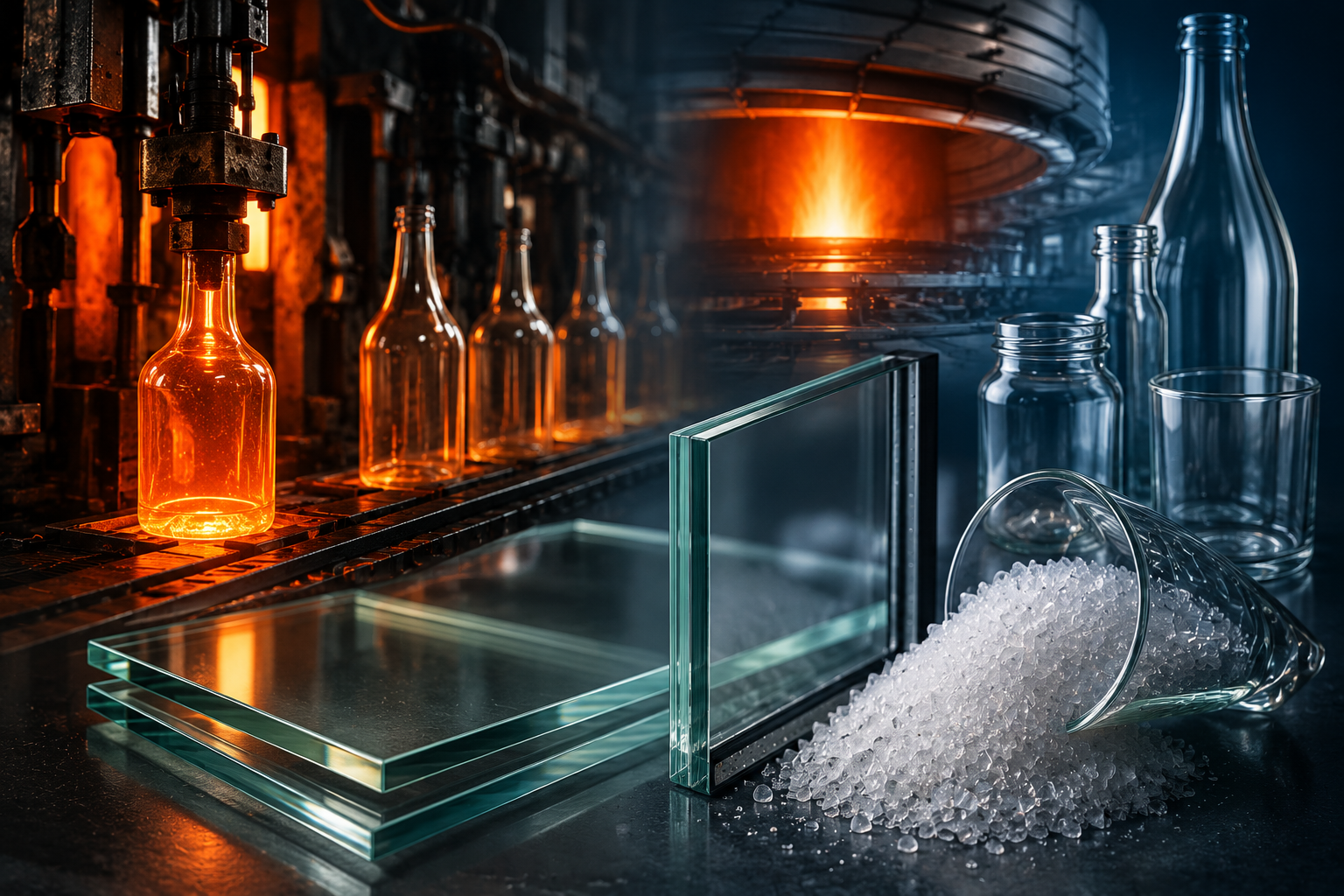
The glass in many smartphone screens, tablet covers, and even some architectural and automotive applications undergoes a process called chemical tempering, or more specifically, ion exchange strengthening. This is distinct from traditional thermal tempering, which relies on rapid cooling to create compressive stress at the glass surface.
In chemical strengthening, sheets of aluminosilicate glass are submerged in a bath of molten potassium nitrate, typically heated to around 400°C. At this temperature, the potassium ions in the molten salt are small enough — no, actually the reverse is true and worth explaining carefully: the sodium ions naturally present in the glass are smaller than potassium ions. When the glass is bathed in molten KNO₃, potassium ions from the salt diffuse into the glass surface and swap places with the smaller sodium ions already there.
Because potassium ions are physically larger than the sodium ions they replace, they don't fit into the same lattice space. This forces the glass's surface structure to compress, creating a layer of residual compressive stress at the surface, typically extending tens of micrometers deep. Just as compressed springs resist being pulled apart, this compressive layer makes the glass significantly more resistant to the surface flaws and micro-cracks that typically cause glass to shatter.
Why This Matters for Consumer Electronics
The result is glass that can be thinner and lighter while still withstanding drops, scratches, and everyday wear far better than untreated glass. This is the basic principle behind branded strengthened glass products used across the electronics industry, and it's a direct industrial application of potassium nitrate's ionic properties — completely unrelated to its role as a plant nutrient or an oxidizer.
The glass industry consumes substantial quantities of potassium nitrate for this purpose, and the chemistry has become foundational to the durability expectations consumers now have for their devices. Manufacturers continually refine bath temperature, immersion time, and glass composition to maximize the depth and magnitude of the compressive stress layer, since these factors directly determine how much impact and scratch resistance the finished product will have.
Pyrotechnics: A Historical and Modern Oxidizer
Perhaps the oldest known industrial use of potassium nitrate is also one of its most visually spectacular: its role as an oxidizer in pyrotechnic compositions, most notably black powder.
A Bit of History
Potassium nitrate has a documented history stretching back over a thousand years, playing a central role in the earliest gunpowder formulations developed in ancient China. Its unique ability to release oxygen when heated made it possible to sustain rapid combustion even in sealed or oxygen-poor environments — a property no ordinary fuel-air mixture could match. That single characteristic launched centuries of use in propellants, signal flares, and eventually, celebratory fireworks.
The Oxidizer's Role
In modern pyrotechnics, potassium nitrate's job is straightforward from a chemistry standpoint, even if the engineering behind a well-designed firework is anything but simple. As an oxidizer, it supplies the oxygen atoms needed to sustain combustion of the fuel components in a pyrotechnic mixture, allowing the reaction to proceed quickly and reliably, independent of the surrounding air supply. This is essential in fireworks, where compositions are often packed densely and need to ignite predictably in a fraction of a second.
Beyond black powder, potassium nitrate is used in some slower-burning compositions, such as certain smoke devices and specialty igniters, where its decomposition characteristics are well suited to controlled, sustained burning rather than rapid combustion.
An Industry Bound by Strict Regulation
It's worth emphasizing that commercial and display fireworks are manufactured by licensed professionals under substantial regulatory oversight, precisely because oxidizer-fuel mixtures can be dangerous if handled, stored, or manufactured improperly. Regulatory bodies in most countries — including agencies overseeing explosives, transportation, and consumer product safety — set strict standards for the manufacture, storage, transport, and public sale of pyrotechnic materials. This is not a casual hobbyist chemistry topic, and for good reason: the same oxidizing power that makes potassium nitrate useful in fireworks also makes uncontrolled mixtures genuinely hazardous.
For consumers, the practical takeaway is simple: enjoy fireworks displays produced by licensed professionals, and treat any pyrotechnic materials, including consumer-grade sparklers or novelties, according to the safety guidance provided by manufacturers and local authorities.
The Common Thread
What ties together thermal energy storage, smartphone glass, and pyrotechnics — three applications that seem to have almost nothing in common on the surface — is the underlying chemistry of potassium nitrate itself. Its thermal stability makes it a reliable heat-storage medium at hundreds of degrees Celsius. Its ionic size, larger than sodium, makes it useful for physically strengthening glass through ion exchange. And its oxidizing power, one of the earliest properties humans ever harnessed from this compound, still finds use in modern pyrotechnic formulations.
It's a good reminder that industrial chemistry rarely respects the tidy categories we impose on it. A compound developed and mass-produced primarily for agricultural fertilizer has, through the same fundamental properties that make it useful for crops, found its way into renewable energy infrastructure, the manufacturing of consumer electronics, and an art form with a thousand-year history.
Looking Ahead
As demand grows for grid-scale energy storage to support intermittent renewables like solar and wind, molten salt systems — potassium nitrate blends among them — are likely to see continued investment and refinement. Meanwhile, the consumer electronics industry shows no sign of slowing its reliance on chemically strengthened glass, meaning potassium nitrate's role in ion-exchange baths will likely persist as device makers chase ever-thinner, more durable screens. And while fireworks remain a comparatively niche industrial application by volume, potassium nitrate's centuries-long role in pyrotechnics is a testament to just how enduring — and how surprisingly diverse — this simple, familiar salt's chemistry really is.
From greenhouse to glass factory to solar farm, potassium nitrate is a quiet reminder that the most interesting chemistry is often hiding in plain sight, in compounds we think we already understand.