Why Chemical Distributors Still Matter in a Direct-Manufacturer World
For the better part of two decades, industry analysts have predicted the slow fade of the chemical distributor. The logic seemed straightforward: as manufacturers grew larger and digital platforms made it easier to find suppliers, buyers would simply go straight to the source. Cut out the middleman, save on margin, and streamline the supply chain. It's a story that has played out in other industries — think of how e-commerce reshaped retail, or how software marketplaces disrupted traditional licensing.
And yet, chemical distribution hasn't disappeared. If anything, distributors have grown more essential, not less, even as direct-from-manufacturer purchasing has become easier than ever. Understanding why requires looking past the simple economics of "buying direct" and into the operational, logistical, and relational complexity that defines the chemical industry.
The Direct-Manufacturer Promise — and Its Limits
The appeal of buying directly from a chemical manufacturer is easy to understand. In theory, it removes a layer of markup, shortens the communication chain, and gives buyers a direct line to the people who actually produce the material. For large-volume purchasers with predictable, consistent needs, this can work well. A company that buys the same resin in bulk, month after month, from a single producer, may have little use for a distributor.
But that scenario describes a minority of chemical buyers. Most companies — particularly small and mid-sized manufacturers — don't operate that way. Their needs shift with product lines, seasons, customer demand, and formulation changes. They may need twelve different specialty chemicals from eight different producers, in quantities too small to interest a large manufacturer's direct sales team. They may need next-week delivery, not next-quarter delivery. They may need technical guidance on how to use a chemical safely and effectively, not just a data sheet and an invoice.
This is where the direct model runs into its limits. Manufacturers are built to produce chemicals efficiently at scale — not to manage thousands of small, variable, geographically scattered relationships. Asking a chemical producer to also become a nimble, hands-on service provider for every possible customer is asking them to be two different companies at once. Distributors exist precisely because that combination is hard to do well inside a single organization.
Aggregation: Solving the Small-Order Problem
One of the most underappreciated functions of a distributor is aggregation. A single manufacturer typically produces a narrow slice of the chemical portfolio a real-world buyer needs. A coatings formulator, for instance, might require resins, solvents, additives, pigments, and specialty modifiers — sourced from a dozen different producers, each with its own minimum order quantities, shipping terms, and lead times.
Going direct to each of those producers means managing a dozen separate relationships, a dozen separate invoices, a dozen separate delivery schedules, and a dozen separate compliance checks. For a company without a large procurement department, this quickly becomes unmanageable. A distributor consolidates that complexity into a single point of contact, a single purchase order, and often a single shipment. This isn't just a convenience — it's a meaningful reduction in overhead that frees smaller manufacturers to focus on their actual product rather than supply chain administration.
Distributors also solve a problem from the other direction: they let manufacturers avoid the cost of serving thousands of small accounts directly. A producer that makes tank-car quantities of a chemical has no efficient way to sell it in drum or tote quantities to hundreds of small customers. Distributors break bulk, repackage, and redistribute — effectively translating industrial-scale production into commercially usable quantities for the broader market. Without that function, a huge portion of demand would simply go unserved.
Inventory, Logistics and the Value of Being Local
Chemical supply chains are not forgiving of delay. A missed shipment can shut down a production line. A late delivery of a critical additive can push back an entire product launch. Manufacturers, especially large ones, tend to optimize their own production and shipping schedules around efficiency — not around the urgent, unpredictable needs of every downstream customer.
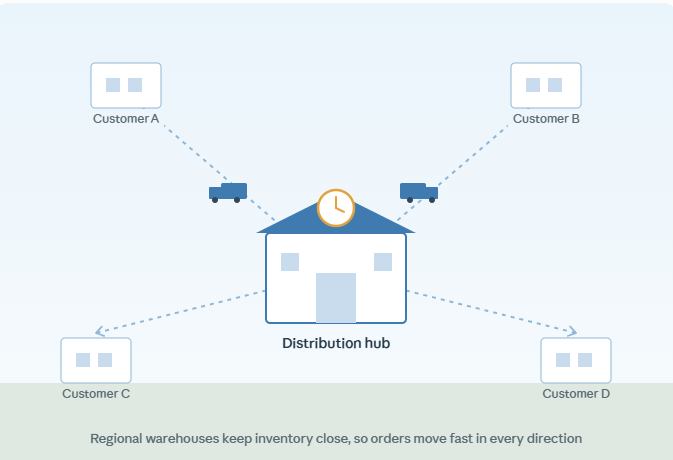
Distributors, by contrast, build their business model around responsiveness. They maintain regional warehouses, hold safety stock, and often can turn around an order in a day or two rather than the weeks a direct manufacturer relationship might require. This local inventory buffer is not a minor convenience; it's often the single biggest reason companies choose to work with a distributor rather than go direct, even when the per-unit price might be marginally higher.
There's also a logistics dimension that's easy to underestimate: hazardous materials handling. Chemicals often come with regulatory requirements around transportation, storage, and handling that vary by state, country, and even municipality. Distributors that specialize in this work have invested in the permitting, equipment, and trained personnel needed to move these materials safely and legally. A manufacturer selling direct to a customer without that same infrastructure risks compliance headaches — or worse, safety incidents — that a specialized distributor is built to prevent.
Technical Expertise and the Human Layer of Chemistry
Chemicals are not commodities in the way that, say, office supplies are. Formulation is an art as much as a science, and the "right" chemical for an application often depends on nuances that a data sheet alone cannot capture. A distributor's technical sales team frequently brings hands-on formulation experience, application knowledge, and troubleshooting expertise that a manufacturer's direct sales channel — often optimized for volume, not consultation — may not offer to smaller accounts.
This matters enormously for small and mid-sized manufacturers who don't have large in-house R&D departments. When a formulation isn't performing as expected, or a customer needs a chemical substitute due to a supply disruption, a good distributor can often diagnose the issue and recommend alternatives from across their entire supplier network — not just from one manufacturer's product line. That cross-supplier perspective is something a direct relationship, by definition, cannot offer, because a manufacturer will always be selling from within its own catalog.
This advisory role also extends to regulatory and safety guidance. Chemical regulations — around REACH, TSCA, OSHA standards, and various state-level rules — are complex and constantly evolving. Distributors that work across many chemical classes and industries tend to have broad regulatory literacy that a producer focused on a narrow product range may not need to maintain internally. For customers who don't have dedicated regulatory affairs staff, this guidance can be the difference between smooth compliance and costly missteps.
Risk Management and Supply Chain Resilience
The past several years have offered a real-world stress test of global supply chains, and the results have reinforced the value of distribution networks. When a single plant goes offline due to a natural disaster, a geopolitical disruption, or a force majeure event, buyers who depend on a single manufacturer for a critical input can find themselves with no options.
Distributors, because they typically carry multiple supplier relationships for overlapping or substitute chemistries, can often pivot buyers to an alternative source far faster than a manufacturer relationship allows.
This diversification benefit runs both ways. Distributors also give manufacturers a buffer against demand volatility. Rather than manage the boom-and-bust cycles of thousands of individual end customers, a manufacturer can sell in more predictable volumes to a distributor, who absorbs the variability of retail-level demand. This is a genuine risk-sharing function, not just a sales channel — and it's part of why many manufacturers choose to maintain distributor relationships even when they have the scale to sell direct to some large accounts.
Financial and Administrative Efficiency
There's also a less glamorous but very real reason distributors persist: credit and financial infrastructure. Extending credit terms to thousands of small buyers is a capital-intensive, risk-laden business that many manufacturers simply don't want to be in. Distributors, who specialize in managing accounts receivable across a broad customer base, absorb this function — offering flexible payment terms to buyers while taking on the underwriting risk themselves.
Similarly, the administrative overhead of sourcing — managing purchase orders, certificates of analysis, safety data sheets, customs documentation for imported materials, and invoicing — is significant. For a manufacturer with narrow margins and limited procurement staff, offloading this administrative burden to a distributor is often worth more than the price difference of buying direct. It's an operational simplification with real financial value, even if it doesn't show up as a line item in the same way a unit price does.
Where Direct Purchasing Does Make Sense
None of this means direct purchasing is never the right choice. For large-volume, single-chemistry buyers with dedicated procurement and logistics teams, going direct to a manufacturer can offer real savings and tighter supply chain control. Some manufacturers have also built strong direct-to-customer digital platforms that streamline ordering for straightforward, repeat purchases. In these cases, the overhead a distributor removes for smaller buyers simply doesn't apply — the buyer already has the scale and infrastructure to manage it themselves.
The reality is that the market has room for both models, and increasingly, for hybrid approaches. Many manufacturers now sell both directly to their largest accounts and through distributors for the long tail of smaller, more variable customers — recognizing that different customer segments have fundamentally different needs.
The Evolving Role of the Distributor
It's worth noting that distributors themselves have had to evolve to remain relevant. The most successful chemical distributors today aren't just middlemen moving product from point A to point B — they're investing in digital ordering platforms, data-driven inventory forecasting, and expanded technical service offerings to justify their place in the supply chain. Distributors that fail to add this kind of value are indeed vulnerable to disintermediation, particularly for simple, high-volume, low-complexity purchases. But distributors that lean into their strengths — technical expertise, logistical agility, aggregation, and risk management — continue to find strong demand for their services.
This evolution suggests that the future of chemical distribution isn't a binary choice between "distributor" and "direct," but a continued specialization of the distributor role around the functions that are genuinely hard to replicate: local responsiveness, cross-supplier technical guidance, small-order aggregation, regulatory navigation, and financial flexibility.
Conclusion
The prediction that direct manufacturer relationships would render distributors obsolete missed something important about how the chemical industry actually functions. Chemical buying isn't just about acquiring a commodity at the lowest possible price — it's about managing complexity: variable order sizes, urgent timelines, safety and regulatory requirements, formulation challenges, and supply chain risk. Distributors have built their entire business model around solving exactly these problems, and that expertise doesn't become less valuable just because a website makes it easier to place an order directly with a manufacturer.
For large, predictable buyers, direct purchasing will continue to make sense. But for the much larger population of small and mid-sized manufacturers who need speed, flexibility, technical support, and simplified logistics, distributors aren't a relic of an older supply chain model — they're a necessary and evolving part of how the chemical industry gets things done. In a direct-manufacturer world, distributors haven't been rendered obsolete. They've simply had to get better at proving why they still matter — and, in large part, they have.