Mining Chemicals Explained: Collectors, Frothers, Depressants and Flocculants
When most people picture a mine, they imagine giant trucks, deep pits, and mountains of rock. What they rarely picture is a chemistry lab. Yet chemistry is the quiet engine behind almost every modern mineral processing plant. Long before a truckload of ore becomes a bar of copper, gold or nickel, it usually passes through a process called froth flotation, and froth flotation runs almost entirely on a handful of specialty chemicals.
These chemicals don't get much public attention, but they determine how efficiently a mine can separate valuable minerals from waste rock, how much metal ends up in the final product, and even how a mine manages its water and tailings. This article walks through the four main families of mining reagents (collectors, frothers, depressants and flocculants) and explains what each one actually does, in plain language.
A Quick Primer: Why Mines Need Chemicals At All
Most metals don't occur in nature as shiny, pure nuggets. They're locked inside ore — rock that contains a mix of valuable minerals (like chalcopyrite for copper, or galena for lead) and worthless material called gangue (mostly quartz, silicates and clays). Even after an ore is crushed and ground into a fine powder, the valuable and worthless particles are still just sitting there, mixed together.
This is where froth flotation comes in. The ground ore is mixed with water to form a slurry, then placed in tanks called flotation cells. Air is bubbled through the slurry, and with the help of chemical reagents, the valuable mineral particles attach themselves to the air bubbles and float to the surface as a mineral-rich froth, while the unwanted gangue sinks and is discarded as tailings. It's essentially a very sophisticated form of sorting by "wettability" — some particles are coaxed into repelling water and clinging to air, while others are encouraged to stay wet and sink.
None of this works reliably without chemistry. That's where collectors, frothers, depressants and flocculants each play their specialized role.
Collectors: Making the Right Minerals Float
Collectors are the reagents responsible for the core trick of flotation: making certain mineral particles hydrophobic, meaning they repel water and are attracted to air bubbles.
In their natural state, most mineral surfaces are hydrophilic (water-loving), which is exactly why they don't float on their own. A collector molecule typically has two parts: a polar "head" that chemically bonds to the surface of the target mineral, and a non-polar "tail" that sticks outward into the water. Once enough collector molecules coat a particle, that tail creates a thin, water-repelling layer around it. When an air bubble bumps into the coated particle, the particle sticks to the bubble instead of the water and rises to the surface with it.
Different minerals need different collectors, because collector chemistry has to match the mineral's surface chemistry:
- Xanthates are the workhorses of sulfide mineral flotation. They're used extensively for copper, lead, zinc, and nickel sulfide ores, bonding strongly to metal sulfide surfaces.
- Dithiophosphates and thionocarbamates are also common for sulfide ores, sometimes used alongside xanthates to fine-tune selectivity or reduce reagent consumption.
- Fatty acids (such as oleic acid) are typically used for non-sulfide minerals like phosphates, or for oxide ores of iron and other metals.
- Amine collectors are widely used in the flotation of potash and certain silicate or oxide minerals, since their positively charged head groups bond well to negatively charged mineral surfaces.
Choosing the right collector (and dosing it correctly) is one of the most important decisions in a flotation circuit. Too little collector and the target mineral won't float efficiently, leaving valuable metal behind in the tailings. Too much, and the collector may start coating unwanted gangue particles too, dragging down the purity, or "grade," of the final concentrate. Getting this balance right is part science, part art, and metallurgists spend enormous effort optimizing collector type and dosage for each specific ore.
Frothers: Building — and Controlling — the Bubbles
If collectors decide which particles are willing to float, frothers decide whether there's a stable froth for them to float into.
Frothers are surfactant chemicals that reduce the surface tension of water and help create small, stable air bubbles throughout the flotation cell. Without a frother, air bubbled through water tends to form large bubbles that rise quickly and burst, offering little chance for mineral particles to attach. Frothers change the physical behavior of the bubbles: they make them smaller, more numerous and, critically, more stable, so they can hold together long enough to carry mineral particles up to the surface and form a persistent froth layer that can be skimmed off.
Common frother chemistries include:
- MIBC (methyl isobutyl carbinol) — one of the most widely used frothers in the industry due to its strong, consistent frothing action and relatively low cost.
- Polyglycol ethers — synthetic frothers that offer good control over bubble size and froth stability, often used where a slower-draining, more robust froth is needed.
- Pine oil and cresylic acid — older, more traditional frothers, still used in some operations, though largely supplanted by synthetic alternatives in many modern plants.
It's worth noting that frothers, unlike collectors, generally don't chemically attach to mineral surfaces — they're mainly there to build and stabilize the froth structure itself. Plant operators watch froth characteristics closely: bubble size, froth height, how quickly it drains, and how "brittle" or "sticky" it looks, because these visual cues tell them a great deal about how the whole flotation process is performing in real time. Too little frother and the froth collapses before it can be collected; too much, and the froth becomes overly stable, trapping unwanted gangue particles and water, which hurts concentrate quality.
Depressants: Keeping the Wrong Minerals Down
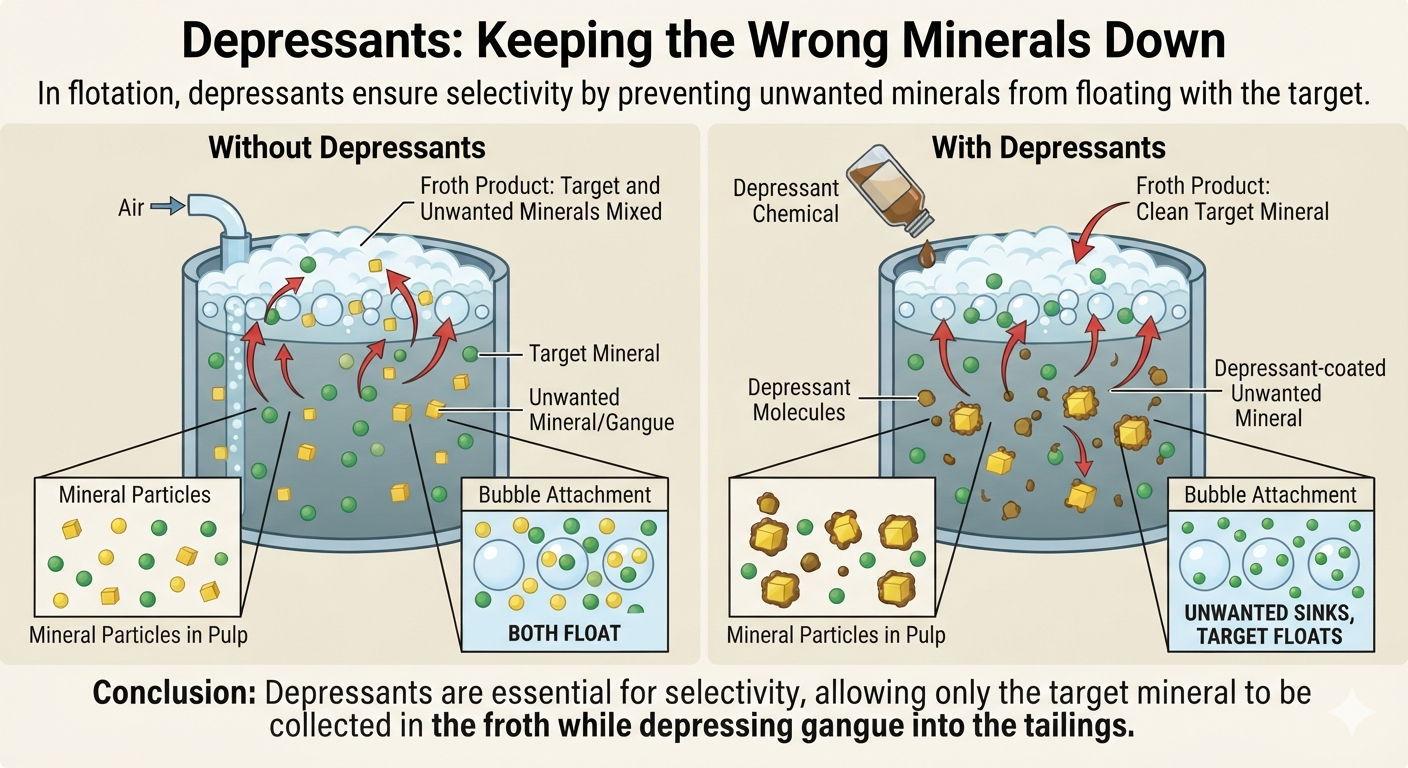
If flotation were only about making the target mineral float, ore processing would be much simpler. The real challenge is usually selectivity — many ores contain several different minerals that could all respond to a given collector. Depressants are the chemicals used to prevent unwanted minerals from floating, so that only the intended target rises to the top.
Depressants work by modifying the surface of the unwanted mineral so that collectors can't attach to it, or by making that surface more hydrophilic so it stays wetted and sinks. This selectivity is what allows plants to process complex ores containing multiple valuable and gangue minerals in sequential flotation stages, each targeting a different mineral.
Common depressants include:
- Lime (calcium hydroxide) — one of the most widely used depressants, particularly for depressing pyrite in copper and gold flotation circuits, by raising the pH of the slurry to a level where pyrite's surface becomes less receptive to collectors.
- Cyanide — historically used to depress sulfide minerals like pyrite and sphalerite (zinc sulfide) in complex ore flotation, allowing minerals such as copper sulfides to be floated selectively first. Its use is tightly regulated due to toxicity concerns, and many operations have moved toward alternative depressants where possible.
- Sodium silicate — commonly used to depress silicate gangue minerals and clays, helping keep them from reporting to the concentrate.
- Starch and dextrin — organic depressants often used in iron ore flotation to depress iron oxide minerals or to disperse fine gangue particles.
- Guar gum and carboxymethyl cellulose (CMC) — polysaccharide depressants used particularly in the flotation of talc-rich or clay-rich ores, and in some nickel and platinum group metal circuits.
Depressants illustrate just how much of mineral processing is about controlling chemistry at the particle surface, molecule by molecule. Small changes in pH, reagent dosage, or even water chemistry can shift how a depressant behaves, which is why plant metallurgists continuously test and adjust dosing as ore characteristics change — even ore from the same mine can vary significantly from one part of the deposit to another.
Flocculants: Bringing Fine Particles Together
Flocculants operate a bit differently from the other three reagent families. While collectors, frothers, and depressants are primarily used inside the flotation cells themselves, flocculants come into play mostly downstream — in thickening, dewatering, and tailings management.
When ore is ground into a fine powder for flotation, it produces enormous volumes of water mixed with very fine solid particles. Separating that water back out — so it can be reused in the plant, and so the leftover solids (tailings) can be safely stored or dried — is a massive engineering challenge. Left alone, fine particles suspended in water can take an extremely long time to settle, because they're so small that gravity barely affects them individually.
Flocculants solve this by encouraging small particles to clump together into larger aggregates called "flocs," which settle out of the water much faster. This is chemically different from what collectors do: flocculants generally work through much larger polymer chains, often with multiple attachment points, that essentially bridge multiple fine particles together into a loosely bound cluster.
The most common flocculants in modern mining operations are:
- Polyacrylamide-based polymers (PAM) — by far the dominant flocculant family today, available in anionic, cationic, and non-ionic forms depending on the charge characteristics of the particles being treated.
- Natural polymers, such as starch-based products, which are sometimes used where biodegradability or cost considerations favor a non-synthetic option.
Flocculants are essential to two critical parts of a modern mine's operation. First, thickeners use flocculants to concentrate slurries and recover process water for reuse, which matters enormously for mines in water-scarce regions. Second, flocculants help manage tailings, encouraging fine waste particles to settle into a denser, more stable material — a factor that has become increasingly important as the industry faces greater scrutiny over tailings dam safety following several well-publicized failures in the past decade. Some newer operations even use flocculants as part of "dry stack" or thickened tailings systems, which produce much less liquid waste than traditional tailings ponds.
How These Chemicals Work Together
It's worth stressing that these four reagent families rarely work in isolation. A typical flotation circuit is really a sequence of carefully balanced chemical additions: pH is adjusted, often with lime; collectors are added to target the desired mineral; frothers generate the bubble structure needed to carry particles to the surface; and depressants selectively hold back minerals that would otherwise contaminate the concentrate. Later, once the valuable concentrate has been separated and the leftover slurry needs to be processed, flocculants take over to help settle solids and recover water.
Metallurgists tune this entire system continuously, because ore is rarely uniform. Mineral composition, grain size, water chemistry, and even temperature can all shift the ideal reagent recipe, sometimes from shift to shift. Modern plants increasingly rely on sensors, automated dosing systems, and even machine learning models to help optimize reagent use in real time, since over- or under-dosing any of these chemicals can significantly affect both the recovery of valuable metal and the cost of production.
Why This Matters Beyond the Plant
Understanding these chemical families also helps explain some of the environmental and regulatory conversations happening around mining today. Reagent choice affects water quality, tailings stability, and the overall environmental footprint of a mine. The industry's gradual shift away from some traditional reagents (like cyanide depressants in certain circuits) toward less toxic alternatives reflects both regulatory pressure and a genuine push within the sector toward more sustainable processing. Similarly, advances in flocculant chemistry are a direct response to growing concern about tailings dam failures and water management in mining regions around the world.
Conclusion
Collectors, frothers, depressants, and flocculants might not be household names, but they are fundamental to how the modern world gets its metals. Each plays a distinct, complementary role: collectors make target minerals float, frothers build the bubbles that carry them, depressants keep unwanted minerals out of the way, and flocculants help settle and recover the water and solids left behind. Together, they turn a pile of crushed rock into the copper wiring in your walls, the lithium in your phone battery, or the gold in a piece of jewelry. The next time you think about where a metal object came from, it's worth remembering that a fair amount of applied chemistry — often invisible, but absolutely essential — helped get it there.