Thermal Decomposition of Nitrates: What Engineers Need to Know
Nitrate compounds are ubiquitous in engineering and industrial chemistry, appearing in everything from fertilizers and pigments to propellants and advanced ceramics. At their core, nitrates are salts of nitric acid containing the nitrate anion (NO₃⁻), a powerful oxidizing group that strongly influences how these materials behave under heat. For engineers, understanding the thermal decomposition of nitrates isn’t just an academic exercise, it’s a practical necessity that affects process design, safety, emissions control and product quality.
Thermal decomposition describes how a substance breaks down when heated, forming new phases and releasing gases. In the case of nitrates, heating can produce nitrites, metal oxides, and reactive nitrogen oxides (NOₓ), often alongside oxygen. These transformations matter across many sectors: chemical manufacturing, where metal oxides are produced by calcination; fertilizers, where storage and handling stability is critical; metallurgy and ceramics, where nitrates are precursors for high-purity oxides; and energetic materials, where oxygen balance and gas evolution drive performance.
This article covers nitrate decomposition from an engineering perspective, linking chemistry fundamentals to process conditions, equipment design, safety, and environmental compliance, so you can make informed decisions when nitrates meet heat.
Understanding Nitrates and Their Chemical Properties
What Are Nitrates?
Nitrates are inorganic salts containing the nitrate anion, NO₃⁻, which consists of one nitrogen atom bonded to three oxygen atoms in a trigonal planar arrangement. The nitrogen is in its highest oxidation state (+5), which explains the oxidizing behavior typical of nitrate salts.
Nitrates form when nitric acid (HNO₃) reacts with bases, oxides, or carbonates. Common classes include:
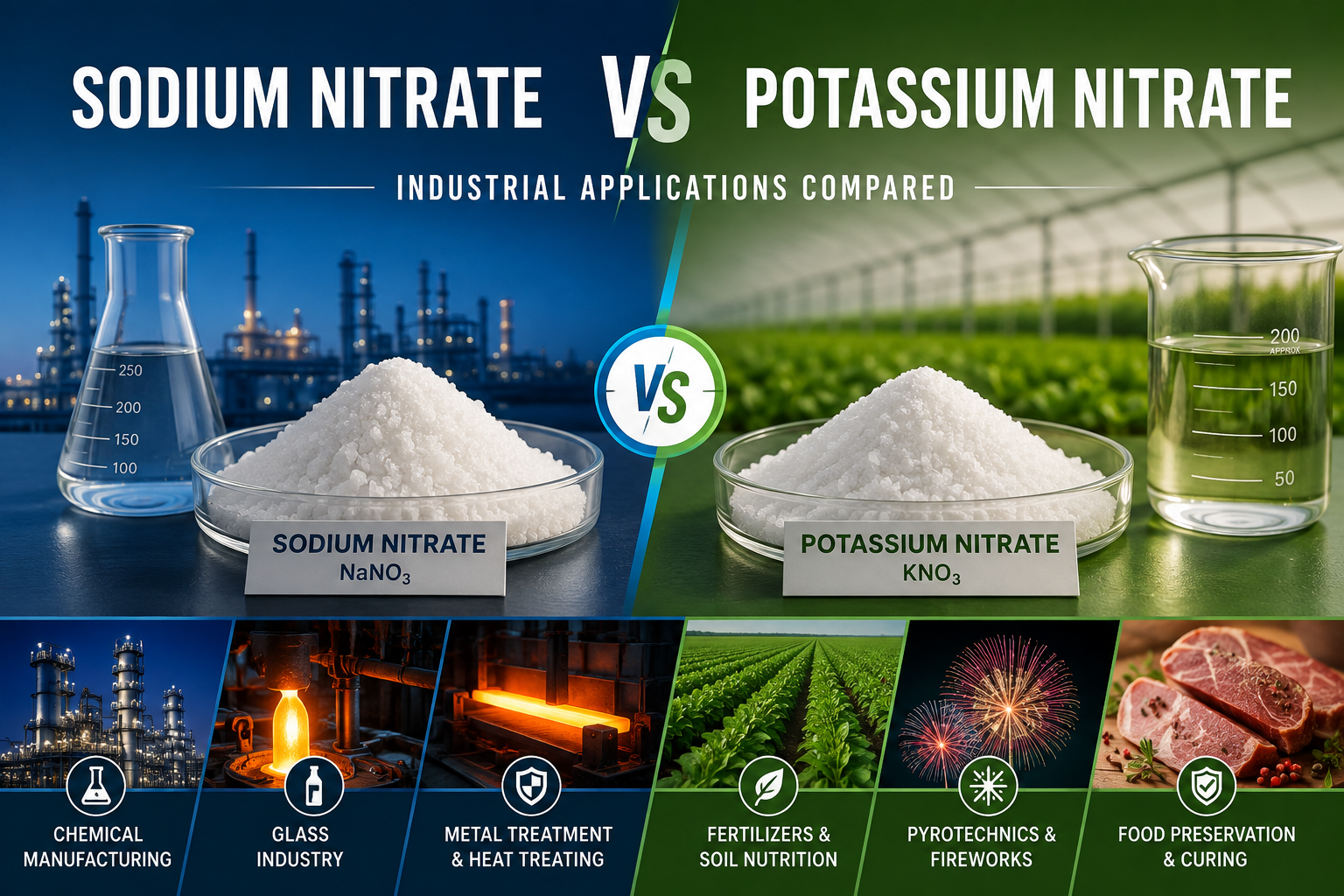
- Alkali metal nitrates: sodium nitrate (NaNO₃), potassium nitrate (KNO₃)
- Alkaline earth metal nitrates: calcium nitrate [Ca(NO₃)₂], magnesium nitrate [Mg(NO₃)₂]
- Transition metal nitrates: copper nitrate [Cu(NO₃)₂], iron(III) nitrate [Fe(NO₃)₃], nickel nitrate [Ni(NO₃)₂]
These salts differ in stability, hydration state, and decomposition pathways because the metal cation controls how strongly the nitrate group is bound and how the lattice responds to heat.
Physical and Thermal Characteristics of Nitrates
From an engineering standpoint, three properties dominate nitrate behavior:
- Solubility and hygroscopic nature
Many nitrates are highly soluble in water and readily absorb moisture from the air. This hygroscopicity affects storage, flowability, and thermal behavior because absorbed water must be driven off before true nitrate decomposition begins. - Melting points vs. decomposition temperatures
Some nitrates melt before they decompose (e.g., NaNO₃ melts at ~308 °C and decomposes above ~380–400 °C), while others decompose without a clear liquid phase. The gap between melting and decomposition temperatures determines whether a process involves molten salt handling or solid-state reactions. - Oxidizing behavior
Because NO₃⁻ is an oxidizer, heated nitrates can release oxygen, which can intensify combustion or oxidation of nearby materials. This is central to both useful applications (e.g., oxygen supply in pyrotechnics) and hazards (e.g., runaway reactions).
Fundamentals of Thermal Decomposition
What Is Thermal Decomposition?
Thermal decomposition is a chemical reaction in which a compound breaks down into simpler substances when heated. For engineers, it’s best understood as a temperature-driven transformation that alters phase, composition, and energy content.
Depending on the system, decomposition may be:
- Endothermic – absorbing heat (common for many nitrate decompositions)
- Exothermic – releasing heat (possible when oxygen released oxidizes other components)
In practical terms, decomposition starts when the supplied heat overcomes the lattice energy holding the ions together, allowing bonds to break and new species to form.
Factors Affecting the Decomposition of Nitrates
Several variables control the nitrate decomposition temperature and pathway:
- Temperature
Each nitrate has a characteristic onset temperature. Engineers must consider not just the peak temperature but the full thermal profile. - Heating rate
Fast heating can shift apparent decomposition to higher temperatures and may cause uneven reactions or hot spots. Slow, controlled heating allows gases to escape and reactions to equilibrate. - Atmospheric conditions (air vs. inert gas)
In the air, released oxygen and NOₓ can further react. In inert atmospheres (e.g., nitrogen or argon), decomposition products may differ, and oxidation of other components is minimized. - Presence of catalysts or impurities
Trace metals, moisture, or organics can catalyze or alter decomposition, lowering stability and increasing NOₓ formation.
Decomposition Mechanisms of Different Nitrate Classes
Alkali Metal Nitrates (e.g., NaNO₃, KNO₃)
Alkali metal nitrates are among the most thermally stable. When heated sufficiently, they typically undergo a nitrate-to-nitrite conversion.
This reaction releases oxygen gas and forms the corresponding nitrite. Key engineering implications include:
- Oxygen evolution can intensify oxidation of surrounding materials.
- Molten phase processing is possible because NaNO₃ and KNO₃ melt before decomposing, enabling use as heat-transfer salts.
- The thermal stability of nitrates in this class is relatively high, making them suitable for high-temperature applications up to their decomposition onset.
Alkaline Earth Metal Nitrates (e.g., Ca(NO₃)₂, Mg(NO₃)₂)
These nitrates decompose differently, usually forming the metal oxide directly.
Here, the products include a solid oxide and gaseous nitrogen dioxide and oxygen. Engineering considerations include:
- Gas evolution (NO₂ and O₂) can build pressure in closed systems.
- Calcination processes often rely on this pathway to produce fine, high-purity oxides for ceramics and catalysts.
- Decomposition temperatures are lower than for alkali nitrates, making control easier but also increasing the risk of unintended reactions during drying or storage.
Transition Metal Nitrates
Transition metal nitrates are the least thermally stable and often decompose in multiple steps, frequently via hydrated intermediates:
- Dehydration (if hydrated)
- Formation of basic nitrates or oxynitrates
- Final conversion to metal oxide
Characteristics include:
- Significant NOₓ emissions from nitrates, particularly NO₂
- Lower decomposition temperatures, sometimes below 300 °C
- Color changes and phase transitions that can be used as visual indicators in lab and pilot-scale work
For engineers, the challenge is balancing complete conversion to oxide with minimizing NOₓ release and avoiding sintering that reduces surface area.
Engineering Applications of Nitrate Thermal Decomposition
Industrial Chemical Processing
One of the most important uses of nitrate decomposition is the production of metal oxides. Nitrates are ideal precursors because they dissolve easily, coat substrates uniformly, and decompose cleanly to oxides.
Examples include:
- Catalyst manufacturing (e.g., NiO, CuO, Fe₂O₃)
- Pigments and ceramics, where oxide purity and particle size are critical
- Battery materials, where controlled calcination of nitrate-derived precursors determines electrochemical performance
Engineers design calcination kilns and furnaces with precise temperature control to achieve full decomposition without unwanted agglomeration.
Energetic Materials and Pyrotechnics
In energetic formulations, nitrates act as oxygen carriers. Their decomposition releases oxygen that supports the rapid oxidation of fuels.
Design considerations include:
- Matching the
decomposition temperature with the ignition profile of the fuel
- Controlling
gas release rate to shape burn characteristics
- Managing sensitivity and stability during storage
Here, nitrate thermal behavior directly influences performance and safety.
Environmental and Waste Treatment Systems
Thermal treatment is sometimes used to destroy nitrate-containing wastes or convert them into less mobile forms. However:
- NOₓ emissions from nitrates are a major concern.
- Engineers must integrate
afterburners, scrubbers, or selective catalytic reduction (SCR) systems to meet emission limits.
- Energy efficiency and secondary pollution control become central design goals.
Safety, Environmental and Regulatory Considerations
Thermal Hazards and Process Safety
Nitrate decomposition can pose hazards due to:
- Runaway reactions if oxygen release accelerates oxidation
- Gas pressure buildup in sealed or poorly vented equipment
- Compatibility issues with organics, oils, or reducing agents
Engineers mitigate these risks with:
- Proper
venting and pressure relief
- Inert atmospheres where appropriate
- Strict material compatibility and housekeeping standards
Environmental Impact of Decomposition Products
The main environmental issue is NOₓ emissions, which contribute to smog, acid rain, and respiratory problems. Mitigation strategies include:
- Optimizing temperature to minimize NO₂ formation
- Using
SCR or SNCR systems for flue gas treatment
- Capturing and neutralizing acidic gases
Relevant Engineering Standards and Regulations
Key regulatory frameworks include:
- OSHA (worker safety, handling of oxidizers)
- EPA (air emissions, waste treatment in the U.S.)
- REACH (chemical safety and compliance in the EU)
Engineers must design processes that meet both safety and environmental performance requirements.
Experimental and Analytical Techniques Used by Engineers
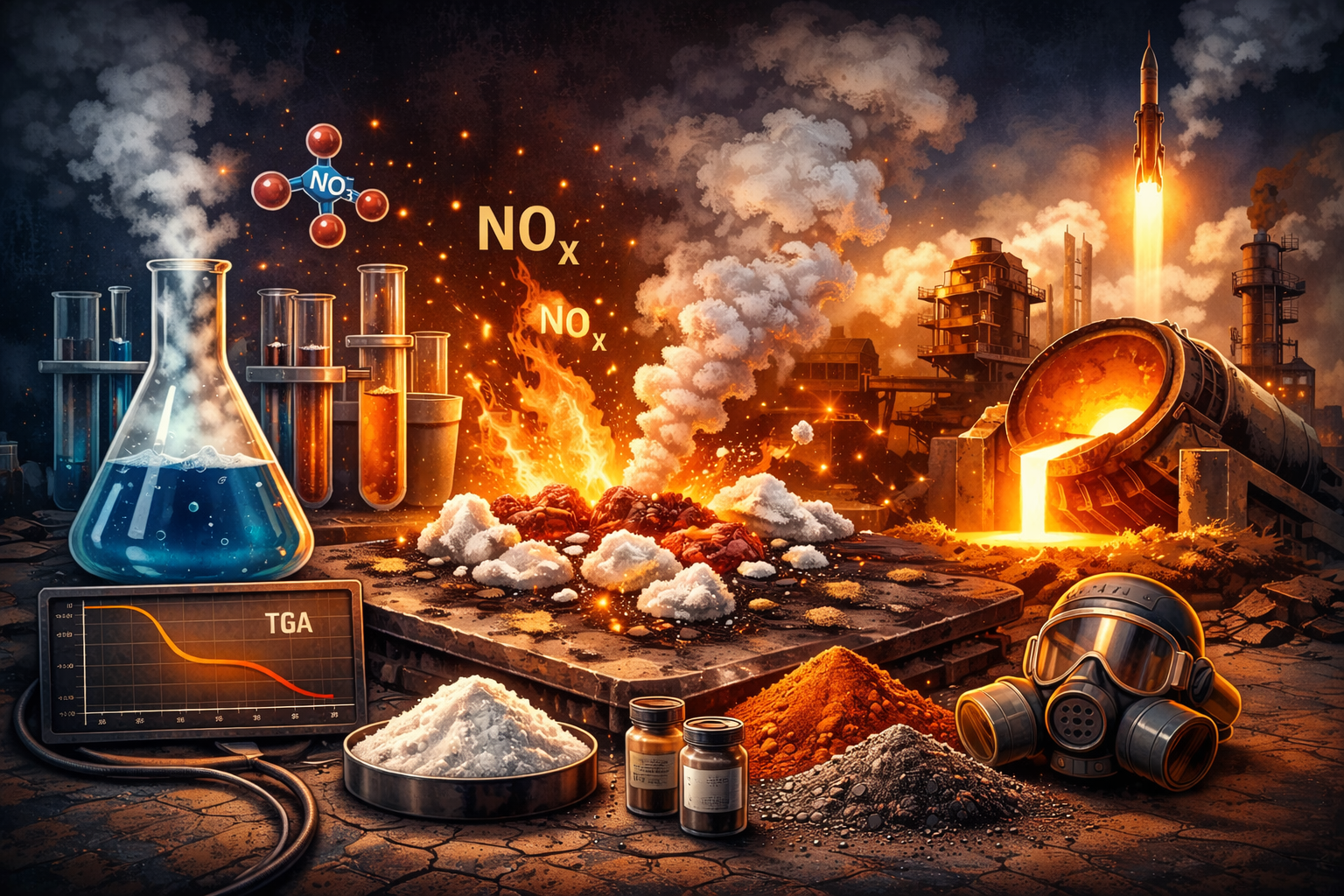
Thermogravimetric Analysis (TGA)
TGA measures mass loss as a function of temperature. For nitrates, it reveals:
- Dehydration steps
- Onset of decomposition
- Total mass change corresponding to gas release
This is essential for determining the thermal stability of nitrates.
Differential Scanning Calorimetry (DSC)
DSC tracks heat flow during heating. It identifies:
- Endothermic decomposition events
- Exothermic
secondary reactions
Engineers use DSC to understand energy balances and design safe heating profiles.
Gas Analysis and Spectroscopy
Techniques such as FTIR or mass spectrometry identify gases like NO₂, NO, and O₂. This helps in:
- Designing emission controls
- Validating reaction mechanisms
Key Design Takeaways for Engineers
Thermal decomposition of nitrates is predictable but highly dependent on composition and conditions. Alkali nitrates tend to form nitrites and oxygen, alkaline earth nitrates form oxides with NOₓ, and transition metal nitrates follow complex, multi-step pathways. For engineers, the essentials are:
- Know the
nitrate decomposition temperature and heating profile
- Design for controlled gas release and venting
- Select materials and atmospheres that prevent unwanted oxidation
- Integrate emissions control from the outset
Careful control of the thermal environment turns nitrate decomposition from a hazard into a powerful processing tool.
Frequently Asked Questions (FAQs)
At what temperature do nitrates typically decompose?
It depends on the cation. Alkali nitrates, such as NaNO₃ decompose above ~380–400 °C, while many transition metal nitrates decompose below 300 °C. Hydration and impurities can shift these values.
Why do some nitrates form nitrites while others form oxides?
The stability of the metal–oxygen bond controls the pathway. Alkali metals favor nitrite formation with oxygen release, while alkaline earth and transition metals form stable oxides directly.
How can engineers minimize NOₓ emissions?
By optimizing temperature, using inert atmospheres when possible, and installing flue-gas treatment systems like SCR or scrubbers.
Are all nitrates thermally unstable?
All nitrates will decompose at sufficiently high temperatures, but their
thermal stability varies widely. Alkali nitrates are among the most stable, while many transition metal nitrates are relatively unstable.