Nitrate Salts in Oxidation Reactions: Controlling Reactivity and Selectivity
Oxidation reactions are central to modern chemistry. From transforming raw materials into pharmaceuticals and polymers to modifying surfaces for advanced materials, oxidation underpins countless laboratory and industrial processes. At its core, oxidation involves the transfer of electrons, often accompanied by the addition of oxygen or the removal of hydrogen, and the challenge for chemists is to make these transformations efficient, predictable and selective.
Inorganic salts have long played roles as oxidizing agents or as components in oxidation systems. Among them, nitrate salts occupy a unique niche. The nitrate ion (NO₃⁻) is thermodynamically stable yet capable of participating in electron-transfer processes under appropriate conditions. This balance makes nitrates particularly interesting for controlling reactivity, how strongly and how fast an oxidation proceeds - and selectivity, where and how the oxidation occurs on a molecule.
Why do nitrate salts matter so much? First, they can be tuned. By pairing the nitrate anion with different metal cations, chemists adjust solubility, redox potential, and coordination behavior. Second, nitrates often enable milder oxidation conditions than traditional “harsh” oxidants, helping preserve sensitive functional groups. Ultimately, nitrate-mediated oxidation systems are utilized in both academic research and industrial applications, encompassing catalysis, materials processing, and sustainable chemistry initiatives. Understanding how nitrate salts influence oxidation chemistry is therefore essential for designing reactions that are not only effective, but also controllable and selective.
Fundamental Properties of Nitrate Salts
Chemical Structure and Oxidation Potential
The nitrate ion is a planar, trigonal species with three equivalent N–O bonds, resulting from resonance. This delocalization stabilizes the anion and distributes negative charge evenly across the oxygen atoms. Structurally, this makes nitrate less reactive than some other oxygen-rich anions, yet still capable of participating in redox chemistry when properly activated.
From a thermodynamic standpoint, nitrate’s oxidation potential reflects a balance between stability and reactivity. On its own, NO₃⁻ is not a strong oxidant under ambient conditions. However, when associated with certain metal cations or in specific chemical environments, nitrate can become part of an effective oxidation system. The key lies in how the surrounding context - metal center, solvent, and reaction medium - modulates electron transfer.
In redox terms, nitrate can act as an electron acceptor, particularly in systems where the metal-nitrate complex facilitates the process. The oxidation potential is not a fixed property of nitrate alone; it is a property of the entire system in which nitrate is embedded. This system-level view is crucial to understanding why nitrate salts are valuable tools for fine-tuning oxidation chemistry.
Common Metal Nitrate Salts Used in Oxidation
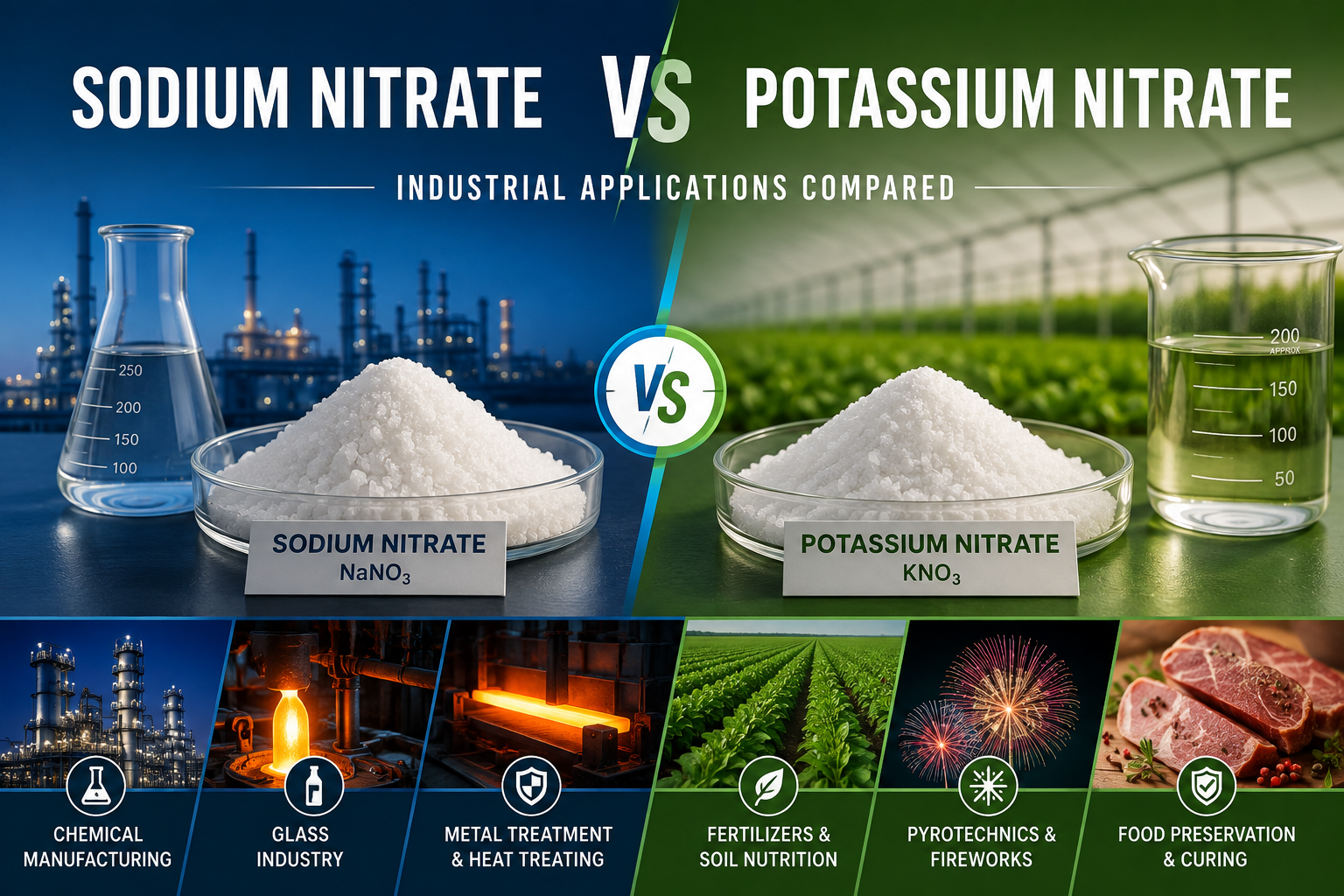
Nitrate salts span the periodic table. Alkali metal nitrates (such as those of sodium or potassium) are highly soluble and often serve as sources of nitrate in homogeneous systems. Their cations are largely spectators, influencing solubility and ionic strength more than redox behavior.
Transition-metal nitrates introduce another dimension. Metals such as copper, iron, cobalt, or manganese can coordinate nitrate and participate directly in electron transfer. In these cases, the metal center and the nitrate ligand work together: the metal may cycle between oxidation states, while nitrate stabilizes intermediates or contributes to the overall oxidizing power.
Reactivity trends depend on both the metal and the environment. Alkali metal nitrates are typically mild and require activation, while transition-metal nitrates can engage more directly in oxidation pathways. Importantly, this diversity allows chemists to select nitrate salts that align with the desired balance of strength and selectivity.
Mechanistic Role of Nitrate Salts in Oxidation Reactions
Electron Transfer and Oxygen Donation Pathways
At a high level, oxidation reactions mediated by nitrate salts involve electron transfer processes facilitated by the nitrate-containing system. Rather than acting as brute-force oxidants, nitrates often participate in more nuanced pathways. The metal-nitrate assembly can accept electrons from the substrate, sometimes with transient formation of reactive oxygen species or metal-oxo intermediates.
Compared with classic oxidants like permanganate or chromate, nitrate-based systems tend to operate through more controlled, stepwise mechanisms. Instead of rapidly over-oxidizing a substrate, the reaction can proceed through defined intermediates that allow the chemist to “steer” the outcome. This mechanistic subtlety is one reason nitrate salts are attractive in selective oxidation chemistry.
Importantly, these pathways are usually discussed in theoretical or conceptual terms rather than as specific procedures. The key takeaway is that nitrate salts contribute to oxidation not simply by donating oxygen, but by shaping the electron-transfer landscape in a way that favors certain transformations over others.
Influence on Reaction Kinetics
Reaction kinetics (how fast a reaction proceeds) are closely tied to the nature of the oxidizing system. Nitrate salts influence kinetics in several conceptual ways. First, they affect the availability of reactive species. A metal nitrate that readily dissociates or coordinates in solution can create a dynamic equilibrium of active forms, modulating the effective concentration of oxidizing agents.
Second, nitrate salts can stabilize reaction intermediates. By coordinating to developing charges or radical-like species, the nitrate-metal environment can lower activation barriers and smooth the energy profile of the reaction. This often translates into moderate reaction rates that are easier to control than those of highly aggressive oxidants.
From a theoretical standpoint, nitrates thus act as “kinetic moderators.” They do not necessarily make reactions extremely fast; instead, they help align reaction speed with selectivity, giving chemists time and control to guide the process toward the desired product.
Controlling Reactivity Using Nitrate Salts
Effect of Counter Ions and Metal Centers
The identity of the metal cation paired with nitrate has a profound effect on oxidation strength. Alkali metals yield salts that are mostly ionic and weakly coordinating, leading to mild behavior. In contrast, transition metals introduce redox activity and coordination chemistry, enabling more potent and versatile oxidation systems.
Solubility is another critical factor. Highly soluble nitrate salts ensure uniform distribution of the oxidizing species, promoting consistent reactivity throughout the medium. Less soluble salts may create heterogeneous environments where reactivity is localized or limited.
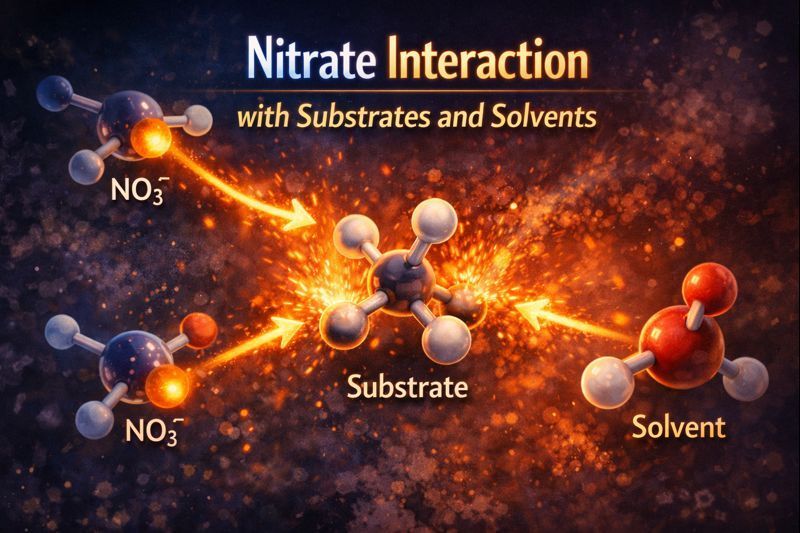
Ionic effects also matter. The size and charge of the metal center influence how nitrate interacts with substrates and solvents. Larger, less polarizing cations tend to leave nitrate more free, while smaller or more highly charged metals draw nitrate into tighter coordination spheres. By choosing the appropriate nitrate salt, chemists can fine-tune how reactive - or how restrained - the oxidation system becomes.
Reaction Environment Considerations
The reaction environment further controls nitrate-mediated oxidations. Solvent polarity, for example, affects how ions are solvated and how strongly they interact with each other. In a conceptual sense, polar solvents stabilize charged species and can enhance the mobility and reactivity of nitrate-based systems, while less polar environments limit these effects.
Temperature and medium also play roles. Higher temperatures generally increase reaction rates, but they can also reduce selectivity if the system becomes too energetic. With nitrate salts, the goal is often to find a balance: enough thermal energy to enable oxidation, but not so much that control is lost.
The key is that nitrate salts are compatible with a range of environments, allowing chemists to adapt conditions conceptually to prioritize either reactivity or selectivity as needed.
Selectivity in Oxidation Reactions Mediated by Nitrates
Chemoselectivity and Functional Group Tolerance
Chemoselectivity refers to a reagent’s preference for one functional group over others. Nitrate-mediated oxidation systems are often valued for their ability to target specific sites without disturbing sensitive groups elsewhere in the molecule. This is particularly important in complex organic molecules that contain multiple reactive functionalities.
Compared with harsher oxidants, nitrate-based systems tend to be gentler. They can oxidize alcohols without cleaving double bonds or modify certain heteroatoms without degrading the carbon framework. Conceptually, this selectivity arises from the controlled electron-transfer pathways and moderated oxidation strength discussed earlier.
Functional group tolerance is therefore a hallmark of nitrate-mediated oxidations. It allows chemists to perform transformations late in a synthetic sequence without undoing previous work.
Regioselectivity and Stereochemical Outcomes
Beyond chemoselectivity, nitrate salts can influence regioselectivity, where on the molecule the oxidation occurs (and stereochemical outcomes) how three-dimensional arrangements are affected. By stabilizing certain intermediates over others, the nitrate-based environment can favor one pathway among several possibilities.
In fine chemical synthesis, this control is invaluable. Producing a specific isomer of a compound can mean the difference between an active pharmaceutical ingredient and an inactive byproduct. Nitrate-mediated systems, when conceptually designed, offer routes to guide oxidation along predictable and controlled pathways.
The overarching idea is that nitrates help make oxidation reactions not just possible, but precise.
Applications of Nitrate-Based Oxidation Systems
Organic Synthesis and Green Chemistry
In organic synthesis, nitrate-mediated oxidations support the principles of green chemistry. They often operate under milder conditions, reducing the need for extreme temperatures or highly toxic reagents. This can lower energy consumption and minimize hazardous waste.
Sustainable oxidation concepts emphasize reduced by-products and efficient atom utilization. Nitrate-based systems, when integrated into catalytic cycles, can align with these goals by enabling controlled transformations with fewer side reactions. While no system is perfectly “green,” nitrates represent a step toward more responsible oxidation chemistry.
Industrial and Materials Chemistry Uses
Industrially, nitrate-based oxidation systems appear in surface treatments, catalyst preparation, and materials modification. Oxidative processes can enhance corrosion resistance, adjust surface energies, or create functional coatings.
In catalytic systems, nitrates may serve as precursors to active metal oxides or as components in redox cycles. At a high level, they contribute to processes where controlled oxidation is essential for performance and durability. These applications highlight the versatility of nitrate salts beyond laboratory-scale reactions.
Environmental and Safety Considerations
Nitrates are ubiquitous in nature and industry, but their environmental persistence requires careful management. In ecosystems, excess nitrates can contribute to nutrient imbalances, underscoring the importance of responsible handling and disposal.
From a regulatory perspective, nitrate-containing chemicals are subject to guidelines that aim to balance utility with environmental protection. Compared with some traditional oxidants, nitrates often have more favorable safety profiles, particularly when used in controlled systems rather than as bulk oxidizers.
In sustainability terms, nitrate-mediated oxidations can be advantageous because they avoid heavy metals like chromium. However, responsible chemistry still demands thoughtful design, proper containment, and consideration of the full life cycle of nitrate-based materials.
Comparison with Other Oxidizing Agents
How do nitrates stack up against classic oxidants such as permanganates, chromates, or peroxides? Permanganates and chromates are powerful and fast, but often too aggressive and environmentally problematic. Peroxides are versatile but can be difficult to control.
Nitrates, by contrast, occupy a middle ground. They are generally milder and more selective, though less forceful in raw oxidation strength. The trade-off is clear: nitrates offer better control and functional group tolerance, while stronger oxidants deliver speed and completeness at the cost of selectivity.
Choosing between these options depends on the goals of the reaction. When precision and sustainability matter, nitrate-based systems are often compelling alternatives.
Future Trends and Research Directions
Looking ahead, research into nitrate-mediated oxidation continues to expand. Emerging catalytic systems seek to use nitrates as components in closed redox cycles, reducing waste and improving efficiency.
Computational chemistry is also playing a growing role. By modeling electron-transfer pathways and intermediate stability, researchers can predict how nitrate systems will behave before testing them in practice. This accelerates the design of selective and sustainable oxidation methods.
Overall, nitrates are poised to remain important players in greener oxidation methodologies, bridging the gap between reactivity and responsibility.
Frequently Asked Questions (FAQs)
Are nitrate salts strong oxidizing agents?
On their own, nitrate salts are generally mild oxidants. Their oxidizing power depends on the metal cation and the chemical environment. In many systems, they provide controlled rather than aggressive oxidation.
How do nitrate salts influence selectivity in oxidation reactions?
They shape electron-transfer pathways and stabilize specific intermediates, allowing reactions to target particular functional groups or positions on a molecule.
Can nitrate-based oxidations be considered green chemistry?
They can support green chemistry principles by operating under milder conditions and avoiding highly toxic metals, though sustainability depends on the overall system design.
What industries rely on nitrate-mediated oxidation processes?
Applications appear in pharmaceuticals, materials science, surface treatments, and catalytic systems where controlled oxidation is essential.
How do nitrates compare to traditional oxidants?
Nitrates are less powerful but more selective and often more environmentally acceptable than classic oxidants like chromates or permanganates, making them attractive for precision chemistry.