How to Read a Certificate of Analysis (CoA): A Buyer’s Practical Guide
Introduction: Why Every Buyer Should Understand a Certificate of Analysis
If you’ve ever purchased supplements, CBD products, cosmetics,
food ingredients, or raw materials online, you may have seen a document labeled “Certificate of Analysis” — often abbreviated as CoA. For first-time buyers, this document can look intimidating. It’s filled with tables, numbers,
laboratory terminology and unfamiliar abbreviations.
But here’s the truth: learning how to read a Certificate of Analysis is one of the most powerful ways to protect yourself as a consumer.
A CoA is not just a piece of paper. It’s proof that a product has undergone analytical testing. It indicates whether the contents of the package match what is printed on the label. More importantly, it verifies whether the product has passed safety compliance standards for contaminants such as heavy metals, pesticides, bacteria, or residual solvents.
In today’s global marketplace, where products cross borders daily, third-party lab testing and independent lab verification are critical trust signals. Brands that provide transparent, batch-specific lab reports demonstrate accountability and commitment to quality assurance testing.
This practical guide will help you confidently understand CoA documents, identify red flags, and verify product authenticity — even if you’ve never read a lab test report before.
What Is a Certificate of Analysis (CoA)?
Simple Definition of a CoA
A Certificate of Analysis is an official laboratory document that verifies a product’s composition, purity, and safety. It summarizes the results of analytical testing methods performed on a specific batch of a product.
A CoA may be issued by:
- An independent ISO certified laboratory (third-party lab testing), or
- The manufacturer’s in-house laboratory
- For buyers, third-party testing is generally considered more reliable because it ensures unbiased evaluation.
Think of a CoA as a product testing report that confirms:
- What ingredients are present
- In what concentration
- Whether contaminants were detected
- Whether the product meets regulatory compliance standards
It is a key tool for product authentication and consumer transparency.
Industries That Use CoAs
Certificates of Analysis are widely used across industries, including:
- Dietary supplements
- CBD & hemp products
- Cosmetics and skincare
- Food and beverages
- Pharmaceuticals
- Raw materials and chemicals
- Nutraceuticals
- Essential oils and plant extracts
In all these sectors, product purity verification and contaminant screening are
critical for safety.
Why First-Time Buyers Often Feel Confused
Many buyers feel overwhelmed when they first see a CoA because:
- The document uses scientific terminology
- Measurements appear in ppm, mg, or percentages
- Regulatory limits are not clearly explained
- Tables look technical and dense
The good news? Once you understand the structure, reading a CoA becomes straightforward.
Step-by-Step Breakdown: How to Read a Certificate of Analysis
1. Verify the Product Information
Start at the top of the document. You should see:
- Product name
- Batch or lot number
- Manufacturing date
- Expiry date
- Sample identification code
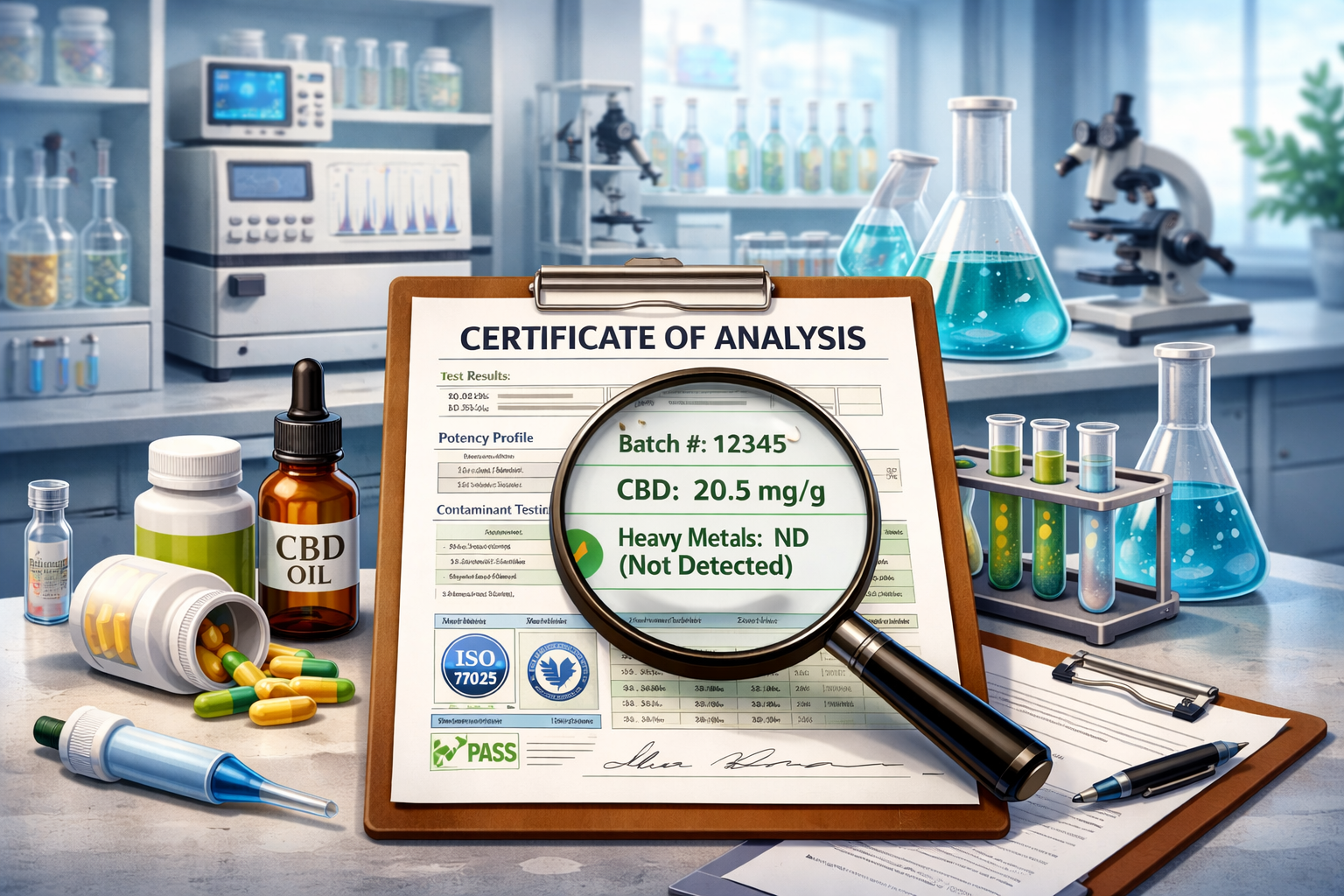
The most important detail here is the batch/lot number. This number must match exactly with the number printed on your product packaging. A batch-specific
lab report ensures the exact production run you purchased was tested — not a generic sample from months ago.
If the batch numbers don’t match, the CoA does not verify your product.
2. Check the Testing Laboratory
Next, locate the laboratory information:
- Lab name
- Address and contact information
- Accreditation status
- Logo or certificate number
Look specifically for
ISO/IEC 17025 accreditation. This is the global standard for testing and calibration laboratories. An ISO certified laboratory has demonstrated technical competence and validated analytical testing methods.
3. Review the Cannabinoid / Ingredient Profile (If Applicable)
For supplements, plant-based extracts, CBD products, or fortified foods, you will see a potency analysis section.
This area lists:
- Active ingredients
- Claimed concentration
- Actual tested concentration
Results may appear in:
- mg (milligrams)
- % (percentage)
- ppm (parts per million)
For example:
- Label claim: 25 mg per serving
- Tested result: 24.7 mg
Small variations are normal and acceptable within regulatory tolerance limits.
This section verifies whether the product delivers on its promises.
4. Look at Contaminant Testing
This is one of the most important parts of understanding CoA documents.
A reliable product testing report should include contaminant screening for:
- Heavy metals (lead, mercury, arsenic, cadmium)
- Pesticides
- Microbial contamination (E. coli, Salmonella, mold, yeast)
- Residual solvents
- Mycotoxins
Each contaminant will show:
- Result
- Unit of measurement
- Acceptable limit
- Pass/Fail status
If a CoA only shows potency but not safety testing, that is a major red flag.
Comprehensive quality assurance testing protects consumers from harmful exposure.
5. Understand “Pass” vs “Fail” Results
Every test result will either meet or exceed regulatory limits.
Key terms include:
- ND (Not Detected)
- Below LOQ
- Pass
- Fail
“ND” does not necessarily mean zero. It means the substance was below the lab’s limit of detection.
The acceptable regulatory limit varies by country and product type. The key point is whether the result falls within safety compliance standards.
Always look for clear “Pass” indicators for contaminant categories.
6. Check the Test Date
A CoA should include:
- Sample received date
- Test completion date
- Report issue date
Testing should be recent and batch-specific. If the report is several years old, it does not guarantee the current product meets regulatory compliance. Fresh testing demonstrates active quality control.
How to Verify a CoA Is Authentic
To ensure certificate validation:
- Scan the QR code on the packaging
- Check the lab’s official website
- Enter the report number in their database
- Confirm batch number matches your product
- Look for digital signatures
- Contact the laboratory directly if unsure
FAQs About Certificates of Analysis
Is a CoA legally required worldwide?
Not always. Requirements vary by country and product type. However, reputable brands provide them for consumer transparency and regulatory compliance.
Can companies fake a Certificate of Analysis?
Unfortunately, yes. That’s why independent lab verification and certificate validation are important.
How recent should a CoA be?
Ideally, it should correspond to the specific batch you purchased and be tested within a short time frame of the manufacturing date.
What does “ND” mean on a lab report?
“Not Detected.” The substance was below the lab’s detection limit.
Should every product batch have its own CoA?
Yes. A batch-specific lab report ensures the exact production run was tested.
Is third-party testing mandatory?
Not always legally required, but it is considered best practice for quality assurance testing and consumer trust.
Final Thoughts
Learning how to read a Certificate of Analysis empowers you as a buyer. Instead of relying solely on marketing claims, you can evaluate independent lab verification, potency analysis, contaminant screening, and regulatory compliance yourself.
In a global marketplace filled with options, transparency is a powerful asset.
The more you understand CoA documents, the more confidently you can choose safe, high-quality products — wherever you are in the world.