Can Green Hydrogen Change the Nitric Acid Industry?
The chemical industry is under pressure. From Brussels to Beijing, regulators, investors, and customers are demanding cleaner production processes, lower carbon footprints, and credible pathways to net zero. For many chemical sectors, the transition is complex but conceptually straightforward — switch energy sources, improve efficiency, and capture emissions. But for the nitric acid industry, the challenge cuts deeper. Carbon is woven into the very feedstock of the process.
That is, unless green hydrogen changes the equation entirely.
At DECACHEM, we work at the intersection of industrial chemistry and sustainable innovation. As the global conversation around green hydrogen accelerates, we've been asking a question that deserves a thorough answer: Can green hydrogen genuinely transform how nitric acid is made, and if so, what would that transformation look like in practice?
Why Nitric Acid Is a Hard Industry to Decarbonize
To understand the opportunity, you first need to understand the problem.
Nitric acid (HNO₃) is one of the foundational chemicals of modern industrial civilization. It is the critical precursor to ammonium nitrate (the world's most widely used nitrogen fertilizer) and a key input in the production of explosives, specialty polymers, nylon intermediates, and a wide range of fine chemicals. Global production sits at roughly 60 million tonnes per year and continues to grow in step with agricultural demand.
The dominant production process is the Ostwald process, a century-old technology that has been refined but not reinvented. It begins with ammonia oxidation over a platinum-rhodium catalyst, which generates nitric oxide (NO), which is subsequently oxidized to nitrogen dioxide (NO₂) and absorbed in water to produce nitric acid. The process is efficient by many measures and has been continuously optimized for energy recovery. But its carbon footprint originates upstream, in how the ammonia feedstock is produced.
Ammonia, which is synthesized via the Haber-Bosch process, is one of the most energy-intensive chemical processes on earth. It accounts for approximately 1.8% of global CO₂ emissions and relies almost entirely on steam methane reforming (SMR) of natural gas to produce the hydrogen it needs. That grey hydrogen — hydrogen made from fossil fuels without carbon capture — is the original sin in the nitric acid supply chain. Fix the hydrogen, and you begin to fix the acid.
Green Hydrogen: The Basic Case
Green hydrogen is produced by electrolyzing water using electricity from renewable energy sources — wind, solar, hydro or geothermal. The process produces no direct CO₂ emissions. When used as a feedstock for green ammonia synthesis, it allows the Haber-Bosch process to run without fossil fuel inputs, producing what is increasingly called "green ammonia."
Green ammonia, fed into the Ostwald process, would yield what could genuinely be called green nitric acid — a product with a dramatically lower lifecycle carbon footprint than its conventional counterpart.
This is not speculative chemistry. The individual steps are all proven at an industrial scale. The challenge is purely economic and infrastructural: green hydrogen is currently two to four times more expensive than grey hydrogen in most parts of the world, the electrolysis capacity needed to replace existing fossil-based hydrogen production is enormous, and the infrastructure to move green hydrogen or green ammonia to nitric acid plants is still nascent.
But the trajectory of costs tells an optimistic story. Electrolyzer costs have fallen by roughly 60% over the last decade and are projected to continue declining significantly through the 2030s. Renewable electricity prices in the best-resourced regions — parts of the Middle East, Chile, Australia, and Scandinavia — are already reaching levels that make green hydrogen economically competitive with grey hydrogen, particularly when carbon pricing is factored in. The International Energy Agency projects that in favorable locations, green hydrogen could match grey hydrogen costs by 2030.
What Green Hydrogen Integration Looks Like in Practice
For an existing nitric acid plant, the transition to green feedstocks involves several layers of change, each with its own timeline and capital requirements.
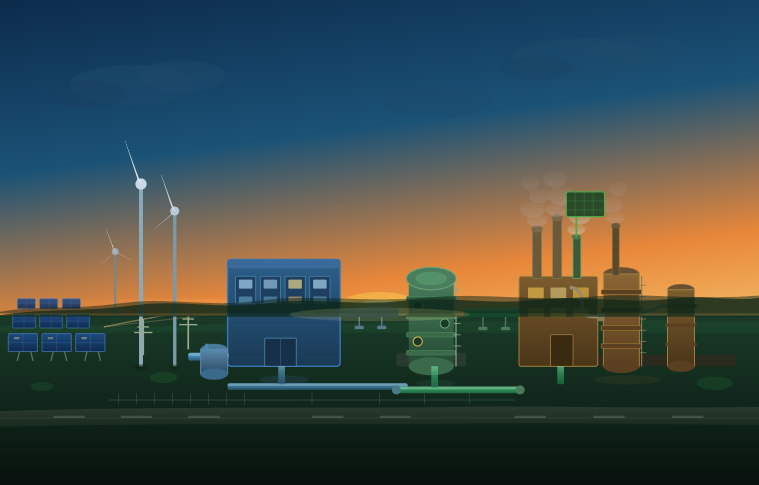
Ammonia sourcing. The most immediate lever is switching from grey ammonia to green or blue ammonia (the latter produced from natural gas with carbon capture). This requires no changes to the nitric acid plant itself — ammonia is ammonia from the perspective of the Ostwald process — but it does require renegotiating supply contracts, building relationships with green ammonia producers, and potentially investing in storage and transport infrastructure to handle supply variability.
On-site electrolysis and synthesis. More ambitious producers, particularly those with access to cheap renewable electricity, are exploring vertically integrated models: producing green hydrogen on-site or nearby, synthesizing green ammonia in co-located Haber-Bosch units, and feeding that directly into acid production. This approach captures more of the value chain and reduces dependence on the still-immature green ammonia trading market, but it demands substantial capital and technical capabilities.
N₂O abatement alongside feedstock transition. It's worth noting that the carbon footprint of nitric acid production is not solely a hydrogen story. Nitrous oxide (N₂O), a potent greenhouse gas with roughly 265 times the warming impact of CO₂ over 100 years, is a byproduct of the ammonia oxidation step in the Ostwald process. Catalytic abatement of N₂O is already economically viable and widely deployed — in some cases, it delivers the largest per-unit decarbonization impact in the short term. A complete green nitric acid strategy addresses both feedstock and process emissions simultaneously.
Regional Dynamics and the Role of Policy
The economics of green hydrogen are highly location-dependent, and the transition in the nitric acid industry will not be uniform across geographies.
Europe is furthest along in policy terms. The EU's Carbon Border Adjustment Mechanism (CBAM), which began phasing in during 2023 and reaches full implementation in 2026, places a carbon price on imports of fertilizers and other chemical products — including nitric acid and its derivatives. This fundamentally changes the competitive calculus for European producers and for exporters into the EU market. Producers who decarbonize their feedstocks and processes gain a tangible pricing advantage. Those who don't face mounting cost pressures.
The EU Hydrogen Strategy and the related RED III renewable energy directive have set ambitious targets for green hydrogen production and consumption within Europe, with specific sub-targets for green hydrogen use in industry. This policy environment is creating real demand signals for producers willing to invest ahead of the curve.
In the Middle East, green hydrogen mega-projects are progressing — Saudi Arabia's NEOM development, Abu Dhabi's ambitious electrolysis capacity targets — with the explicit ambition of becoming major exporters of green hydrogen and green ammonia. If even a portion of this capacity comes online as projected, it could fundamentally alter the economics of green ammonia for European nitric acid producers within this decade.
In North America, the Inflation Reduction Act's generous production tax credits for clean hydrogen have ignited significant investment activity, though the regulatory definitions of what qualifies as "clean" hydrogen continue to evolve.
The Certification and Traceability Question
One factor that the nitric acid industry will need to grapple with as green hydrogen scales is how to credibly demonstrate the provenance of its feedstocks to customers.
Green chemistry claims require verification. The market for green chemicals — including green nitric acid and the green fertilizers and explosives it enables downstream — will require robust certification frameworks. In Europe, the CertifHy standard and the emerging work under the EU Delegated Acts for renewable hydrogen provide a foundation, but the industry-wide infrastructure for tracking renewable hydrogen and ammonia from the point of production through to end-product is still being built.
For nitric acid producers, this is both a compliance requirement and a competitive opportunity. Companies that invest early in digital traceability, verified supply chains, and credible green certifications will be positioned to command premium pricing from downstream customers who themselves face sustainability scrutiny — particularly in the agricultural, specialty chemical, and defense-adjacent markets that consume nitric acid derivatives.
Challenges That Remain
Optimism about green hydrogen's potential should not obscure the genuine difficulties ahead.
The sheer scale of the buildout required is staggering. The existing global grey hydrogen production of roughly 90 million tonnes per year represents an extraordinary base of fossil infrastructure that cannot be replaced overnight. Electrolysis capacity, renewable electricity generation, grid infrastructure, and shipping and storage capabilities all need to scale in concert.
The intermittency of renewable energy creates operational challenges for processes — like ammonia synthesis — that have historically run continuously at steady-state. Green hydrogen and ammonia production will need storage buffers and operational flexibility that conventional processes lack.
Water availability is a genuine concern in some of the regions best-suited for cheap renewable electricity. Electrolysis consumes significant quantities of water, and arid regions with abundant solar resources may face constraints that complicate large-scale green hydrogen development.
And the capital costs of transition are substantial at a time when many chemical producers are navigating tight margins, high energy costs, and uncertain demand outlooks. Financing green transformation requires patient capital, government support mechanisms, and long-term offtake agreements that provide the revenue certainty investors need.
Our Perspective at DECACHEM
We believe green hydrogen is not a distant prospect for the nitric acid industry — it is an arriving reality, moving faster in some regions than others, but moving. The combination of falling electrolyzer costs, rising carbon prices, strengthening policy mandates, and growing customer demand for decarbonized chemicals is creating a structural shift, not a cyclical one.
For producers and buyers in the nitric acid value chain, the question is no longer whether to engage with green feedstock transitions, but how and when. Early movers who build the supply chain relationships, technical capabilities, and certification infrastructure now will be better positioned than those who wait for the technology and economics to fully mature before acting.
At DECACHEM, we are actively tracking the development of green ammonia supply chains, engaging with certification frameworks, and working with partners across the value chain to understand what credible green nitric acid pathways look like at a commercial scale. We don't have all the answers yet — nobody does — but we are committed to finding them.
The chemistry has always been there. Now the economics are beginning to follow.
Have questions about sustainable sourcing or the future of green chemistry in industrial acid production? Get in touch with the DECACHEM team.