Calcium Nitrate in Wastewater Treatment: An Overlooked Environmental Tool
When people think about wastewater treatment, their minds usually jump to the big, visible infrastructure: aeration basins churning with bacteria, clarifiers settling out sludge, or UV disinfection units zapping pathogens before water is released back into a river. Rarely does anyone think about a simple chemical compound that plays a quiet but critical role behind the scenes — calcium nitrate. Yet this unassuming salt has become an increasingly valuable tool for treatment plant operators, municipalities, and industrial facilities seeking to address one of the wastewater industry's most persistent and unpleasant challenges: controlling hydrogen sulfide odor and corrosion.
This post provides a closer examination of calcium nitrate, its working mechanism, its application in real-world treatment systems, and why it warrants more attention than it typically receives.
What Is Calcium Nitrate?
Calcium nitrate, with the chemical formula Ca(NO₃)₂, is an inorganic salt formed from calcium and nitrate ions. In its purest form, it's a white, crystalline, highly water-soluble compound. It's produced industrially at large scale, most commonly as a byproduct of reacting limestone with nitric acid, and it has a long history of use in agriculture as a fertilizer since it supplies both calcium and nitrogen — two nutrients plants need for healthy growth.
Outside of agriculture, calcium nitrate shows up in concrete additives (where it accelerates setting and inhibits corrosion of rebar), in some de-icing formulations, and, increasingly, in wastewater treatment. In this context, the compound is usually sold and applied as a liquid solution rather than a dry crystal, which makes dosing into pipelines and collection systems straightforward.
The Problem Calcium Nitrate Solves: Hydrogen Sulfide
To understand why calcium nitrate matters in wastewater treatment, you first need to understand the problem it's designed to fight: hydrogen sulfide gas, commonly abbreviated H₂S.
Hydrogen sulfide forms in wastewater collection systems — the sewer pipes, lift stations, and force mains that carry sewage from homes and businesses to treatment plants — through the activity of sulfate-reducing bacteria. These microorganisms thrive in anaerobic (oxygen-free) conditions, which are common in long stretches of sewer pipe, especially in force mains where wastewater sits under pressure with little to no dissolved oxygen. The bacteria use sulfate, which is naturally present in wastewater as an electron acceptor for their metabolism, and one of the byproducts of that process is
hydrogen sulfide.
H₂S is a genuine problem for several reasons:
It smells terrible.
Even at extremely low concentrations, hydrogen sulfide produces the unmistakable "rotten egg" odor that generates public complaints near treatment plants, pump stations, and manholes. Odor complaints are one of the most common sources of community friction for wastewater utilities, and persistent H₂S odor can damage a utility's relationship with the neighborhoods it serves.
It's corrosive. When hydrogen sulfide gas rises above the water line in a sewer pipe, it can be oxidized by certain bacteria into sulfuric acid, which attacks concrete pipe, manhole structures, and metal fittings. This process, known as microbially induced corrosion, is one of the leading causes of premature failure in concrete sewer infrastructure. Replacing corroded sewer pipes is enormously expensive, so anything that slows this degradation has direct financial value for a utility.
It's toxic and dangerous. At higher concentrations, hydrogen sulfide is a serious occupational hazard. It's flammable, and at high enough concentrations, it can be lethal to workers who enter confined spaces like wet wells and lift stations without proper precautions. Worker safety programs at treatment facilities take
H₂S exposure extremely seriously.
Given these three problems — odor, corrosion, and toxicity — it's easy to see why utilities are motivated to control
hydrogen sulfide before it ever reaches the treatment plant headworks.
How Calcium Nitrate Controls Odor and Corrosion
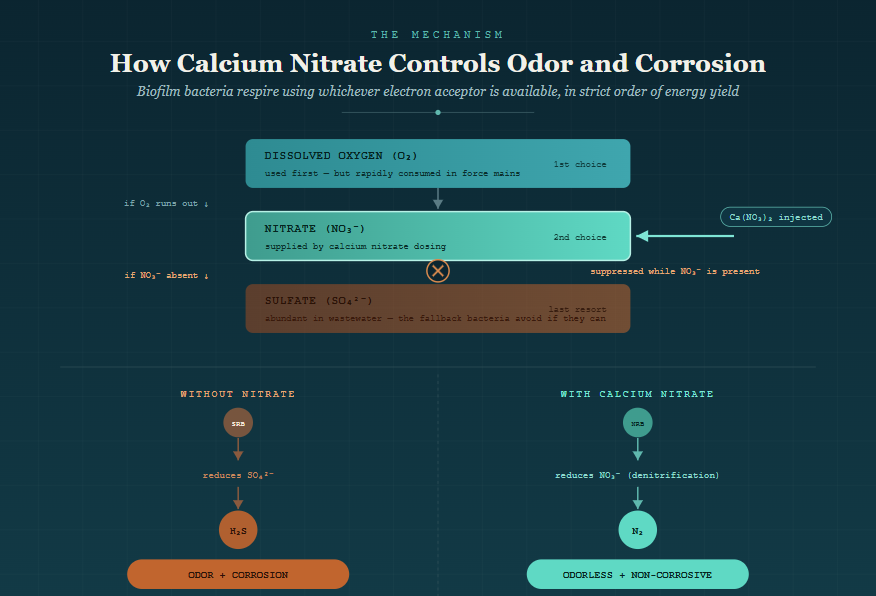
This is where calcium nitrate earns its keep. When dosed into a sewer collection system, the nitrate ion (NO₃⁻) provides an alternative electron acceptor that many bacteria prefer over sulfate. Given the choice, facultative bacteria in the wastewater will use nitrate for their respiration before turning to sulfate reduction, because nitrate reduction is more energetically favorable. This effectively suppresses the activity of the sulfate-reducing bacteria that would otherwise generate hydrogen sulfide.
In simpler terms, calcium nitrate essentially outcompetes the chemical pathway that produces the smell in the first place, rather than trying to mask or remove H₂S after it has already formed. This is a meaningful distinction. Many odor-control approaches — activated carbon scrubbers, chemical scrubbers, or bioscrubbers at the treatment plant — deal with H₂S gas after it has already been generated and released. Calcium nitrate dosing, by contrast, is a preventive strategy applied upstream, often directly into force mains, lift stations, or the front end of a collection system, so that the gas is never produced in meaningful quantities to begin with.
There's a secondary benefit as well. Because the calcium ion is also present in the compound, calcium nitrate dosing can contribute to a small degree of hardness or buffering capacity in the wastewater stream, though this is a much smaller factor in most applications compared to the primary nitrate-driven mechanism.
Where and How It's Applied
Calcium nitrate is typically applied as a liquid solution using metering pumps at strategic points in a collection system:
Lift stations and wet wells: These are common dosing points because wastewater often sits for extended periods in these structures, giving sulfate-reducing bacteria time to establish themselves and generate H₂S. Continuous or intermittent dosing at a lift station can prevent the anaerobic conditions that favor sulfide production downstream.
Force mains: Because force mains are pressurized pipes with no atmosphere at the top of the pipe (unlike gravity sewers, which typically have a headspace), wastewater in a force main can spend hours in a fully anaerobic environment. This makes force mains prime candidates for calcium nitrate dosing, since the retention time gives the compound time to work before the wastewater reaches a point where H₂S would otherwise off-gas.
Long gravity interceptors: In cases where gravity sewers have very long retention times or flat grades, dosing may also be applied to prevent sulfide buildup along the pipe run.
Dosing rates are calculated based on the sulfide load of the wastewater, the retention time in the system, and the specific characteristics of the pipe network. Operators typically work with suppliers or engineers to develop a dosing plan and then monitor H₂S concentrations, either through portable gas detectors or continuous monitoring stations, to fine-tune the dose over time. Overdosing wastes money without providing proportional benefit, while underdosing fails to fully suppress sulfide formation, so this tuning process matters.
Why It's an "Overlooked" Tool
Compared to some of the more prominent chemicals used in wastewater treatment — chlorine for disinfection, ferric chloride for phosphorus removal, or polymers for sludge dewatering — calcium nitrate doesn't get much attention in public discussions of wastewater infrastructure. There are a few reasons for this.
First, it operates upstream in the collection system rather than at the treatment plant itself, so it's physically and conceptually separate from the parts of wastewater treatment people usually picture. Collection system management is often treated as a distinct discipline from plant operations, even though both fall under the same utility's responsibility.
Second, because calcium nitrate dosing is a preventive measure, its success is largely invisible. When it works well, there simply isn't an odor complaint, there isn't a corroded pipe, and there isn't a confined-space incident. Preventive measures rarely get the same attention as visible technologies, because their benefit shows up as an absence of a problem rather than a visible solution.
Third, the compound itself is relatively cheap and unglamorous. It doesn't involve cutting-edge membrane technology, complex biological processes, or striking visual infrastructure. It's a salt dissolved in water, dosed through a pump. That simplicity, ironically, is part of why it's so effective and cost-efficient, but it also means it doesn't generate much interest outside of the wastewater engineering community.
Environmental and Practical Considerations
Calcium nitrate isn't without tradeoffs, and a balanced discussion should acknowledge them.
Nitrogen loading: Because calcium nitrate introduces additional nitrogen into the wastewater stream, treatment plants need to account for this when managing their nitrogen removal processes, particularly if they're subject to strict nutrient discharge limits for total nitrogen. In plants with biological nutrient removal systems, added nitrate can generally be managed within existing denitrification processes, but it's a factor engineers need to model rather than ignore.
Cost considerations: While calcium nitrate is relatively inexpensive as a raw chemical, continuous dosing across a large collection system does have an ongoing operational cost. Utilities need to weigh this against the costs of corrosion-related pipe replacement, chemical odor scrubbing at the plant, and community relations costs tied to odor complaints. In most cases, especially for utilities with significant force main infrastructure, the calculation favors dosing as the more economical long-term choice.
Not a universal fix: Calcium nitrate is most effective as part of an integrated approach to collection system management. It works best when paired with proper system design, adequate aeration where feasible, and monitoring programs that catch problem areas before they become chronic. Relying on chemical dosing alone, without attention to the underlying hydraulic and structural conditions of a sewer system, is unlikely to produce optimal results.
A Case for Wider Recognition
Given the scale of the corrosion and odor problems that hydrogen sulfide creates across aging sewer infrastructure in many cities, calcium nitrate dosing deserves more attention as a proven, comparatively low-cost mitigation strategy. Utilities managing extensive force main networks — which describes a significant share of municipal and industrial wastewater systems — stand to benefit from evaluating whether calcium nitrate dosing fits into their operational strategy, particularly in areas prone to septic conditions or corrosion-related pipe failures.
As sewer infrastructure across the world continues to age, and as public tolerance for odor complaints and infrastructure failures continues to shrink, tools like calcium nitrate dosing are likely to become more prominent components of asset management strategies. It may not be the most visually dramatic technology in the wastewater world, but its role in protecting infrastructure, reducing odor complaints, and improving worker safety makes it a genuinely valuable — if underappreciated — part of the modern wastewater management toolkit.
Final Thoughts
Wastewater treatment is full of these kinds of quiet, unglamorous solutions that don't make headlines but keep systems running smoothly. Calcium nitrate is a good example of chemistry doing exactly what it's supposed to do: intervening at the right point in a biological process to prevent a downstream problem before it starts. For utilities grappling with aging force mains, chronic odor complaints, or accelerating pipe corrosion, it's worth a closer look — not as a flashy new technology, but as a well-understood, cost-effective tool that's been quietly proving its value in collection systems for years.