Total Cost of Ownership: Why Cheapest-Price Chemical Sourcing Often Costs More
In an industry where margins are under constant pressure, it is tempting to treat chemical procurement as a straightforward exercise in price comparison. Find the lowest unit price, place the order, and move on. It is a logic that looks impeccable on a purchase order — and yet it quietly drains profitability in ways that never show up in a single line-item comparison.
Total Cost of Ownership (TCO) is a framework that captures the full economic reality of a sourcing decision. When applied rigorously to chemical procurement, it consistently reveals the same uncomfortable truth: the cheapest supplier on paper is rarely the cheapest supplier in practice. Understanding why — and what to measure instead — is one of the highest-value changes a procurement or operations team can make.
The Illusion of the Unit Price
The unit price of a chemical is the most visible number in any sourcing conversation. It is easy to compare across suppliers, easy to present internally, and easy to optimise for. This visibility is precisely what makes it dangerous as a primary decision metric.
Consider a simple scenario: Supplier A offers a solvent at €0.85/litre. Supplier B offers the same specification at €1.05/litre. The instinct is clear — go with Supplier A. But before that order is placed, several questions deserve serious answers:
• What is Supplier A's on-time delivery rate over the past 12 months?
• How consistent is batch-to-batch quality? What is the rejection or rework rate?
• What minimum order quantities (MOQs) apply, and what carrying costs do they create?
• What is the lead time, and what buffer stock must be held as a result?
• What administrative burden — documentation, compliance, supplier management — does this relationship generate?
Once these factors are quantified, the €0.20/litre saving frequently disappears — and often reverses entirely.
The Hidden Costs That TCO Captures
A robust Total Cost of Ownership model for chemical procurement typically includes the following cost categories — most of which never appear on an invoice.
1. Quality and Non-Conformance Costs
Off-spec chemicals create cascading costs that are seldom attributed back to the sourcing decision. Testing and resampling time, production line stoppages, batch failures, disposal of non-conforming material, and customer complaints all carry real price tags. In regulated industries — pharmaceuticals, food processing, electronics — a single quality failure can mean regulatory action, product recalls, or lost certifications. The cost of a single major non-conformance event routinely exceeds an entire year's worth of unit price savings.
2. Inventory and Working Capital Costs
Suppliers with long or variable lead times force buyers to hold larger safety stocks. Every litre sitting in a warehouse represents tied-up capital, storage cost, potential degradation, and insurance expense. For chemicals with limited shelf lives, overstocking also creates disposal costs and write-offs. A supplier offering reliable short lead times may command a premium that is more than offset by a 30–40% reduction in required inventory levels.
3. Logistics and Handling Costs
Incoterms, packaging specifications, freight mode, and delivery frequency all determine the true landed cost of a chemical. A supplier with a low ex-works price but delivering in non-standard containers or from a distant location can easily add 15–25% to the real cost before the product reaches your production floor. Freight costs are also increasingly volatile, meaning that a sourcing model optimised for a low-freight environment can become significantly more expensive when market conditions shift.
4. Regulatory and Compliance Costs
Chemical procurement carries a distinct regulatory burden. REACH, GHS/CLP, COSHH, ADR, and a growing array of country-specific regulations require accurate Safety Data Sheets, proper classification, and in some cases import authorisations or substance pre-registration. Suppliers who are not fully compliant shift this administrative and legal burden onto the buyer. The internal time spent chasing documentation, completing registrations, and managing compliance gaps is a genuine cost — one that a well-organised supplier absorbs on your behalf.
5. Supplier Management and Transaction Costs
Every supplier relationship has an overhead: onboarding, qualification, audit, communication, dispute resolution, and invoice reconciliation. A fragmented supply base — the natural result of chasing the best unit price across multiple vendors — multiplies these costs. Research consistently shows that reducing supplier count and deepening strategic relationships lowers total procurement cost even when the unit prices paid are somewhat higher.
6. Supply Continuity and Risk Costs
The most underestimated cost in chemical sourcing is the cost of supply disruption. A production line running at 60% capacity because a critical chemical has not arrived costs vastly more per hour than any price differential between suppliers. Suppliers chosen purely on price often have less resilient operations, thinner margins that limit their own investment, and fewer contingency options when their own supply chains are disrupted. The risk premium of a reliable, financially stable supplier is real value — it simply does not appear in a purchase order.
Where TCO Thinking Pays Off Most
Not every chemical purchase warrants a full TCO analysis. A high-volume commodity used in bulk with multiple interchangeable suppliers is a reasonable target for pure price competition. But TCO thinking is particularly valuable — and the cost divergence between apparent and actual cost is typically greatest — in the following situations:
• Specialty or functional chemicals where purity, specification consistency, and technical support are performance-critical
• Chemicals used in regulated end products (pharmaceuticals, cosmetics, food contact materials, medical devices)
• Single-source or limited-availability materials where supply disruption has an outsized operational impact
• High-volume spend categories where even small percentage improvements in total cost have significant absolute value
• Chemicals requiring specialist handling, specific storage infrastructure, or complex regulatory documentation
The Supplier Partnership Advantage
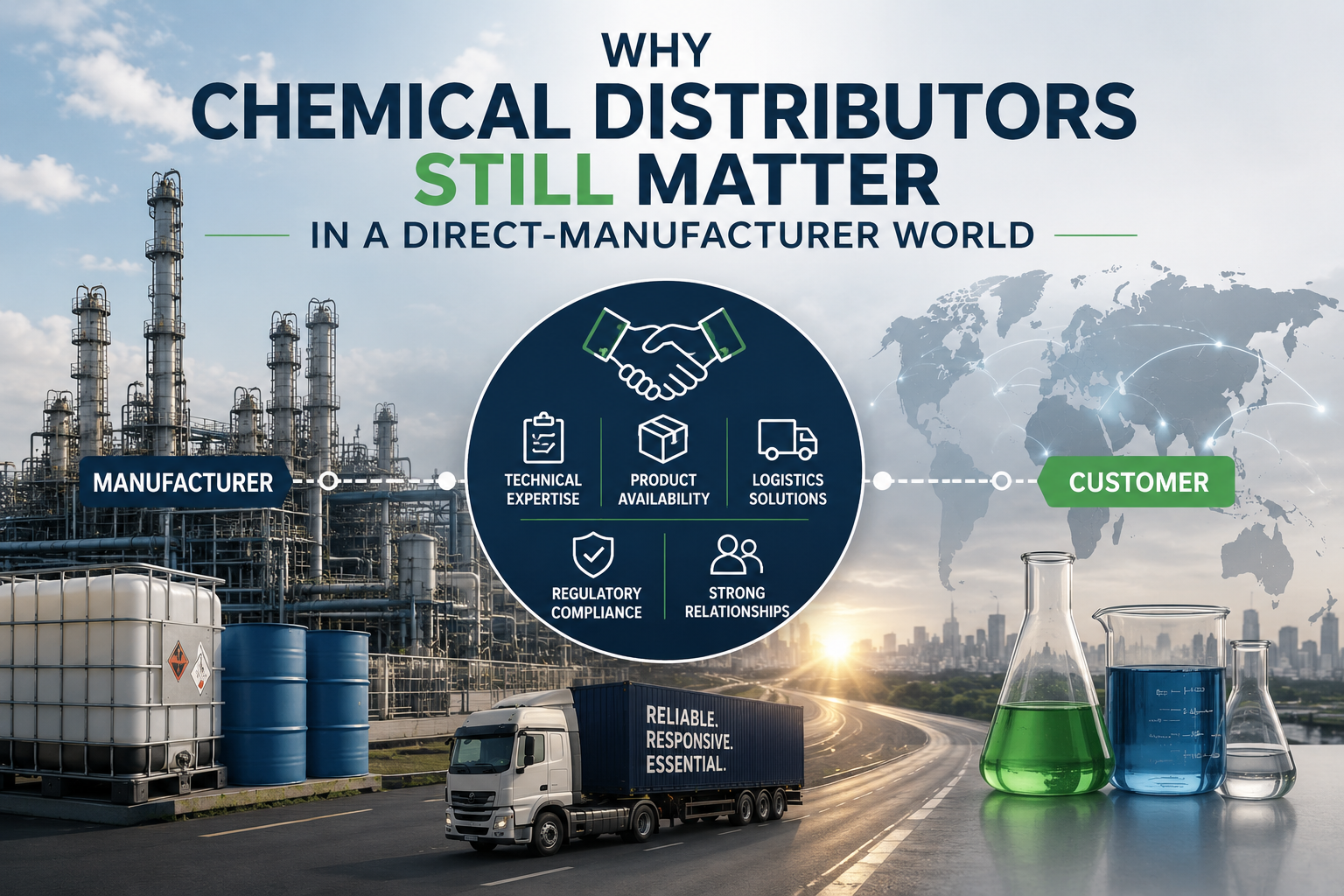
TCO analysis typically points procurement teams in a consistent direction: fewer, deeper supplier relationships with partners who are invested in the customer's operational success. This is not sentiment — it is economics.
A supplier who understands your processes, holds tailored stock, provides responsive technical support, and proactively flags potential supply issues delivers value that is genuinely difficult to price — and genuinely impossible to capture from a vendor selected on unit price alone. The ability to call a knowledgeable account manager when you encounter an unexpected formulation issue, the confidence that your order will arrive on schedule, the certainty that documentation will be in order on day one: these are operational inputs that directly affect your own output quality and delivery reliability.
Over a multi-year horizon, the compounding value of supply reliability, consistent quality, and reduced administrative friction routinely exceeds any unit price advantage that a lower-cost vendor could offer.
Changing the Internal Procurement Conversation
One practical challenge in adopting TCO thinking is organisational: procurement teams are often measured on purchase price variance (PPV), which by design rewards unit price reduction and ignores everything else. Shifting to a TCO framework requires a corresponding shift in the metrics used to evaluate sourcing performance.
This means including operations, quality, logistics, and finance stakeholders in supplier evaluation decisions. It means developing shared cost models that make the hidden costs visible. And it means giving procurement leaders the mandate and the tools to optimise for total value rather than line-item price.
The companies that do this consistently are also the ones with the most resilient supply chains, the fewest production disruptions attributable to chemical quality failures, and — perhaps counterintuitively — some of the best-controlled chemical procurement costs across their organisations.
Conclusion: Procure for Value, Not Just Price
Chemical procurement has never been purely transactional, even when it has been treated that way. The properties of the materials you buy affect your products, your production stability, your regulatory standing, and your customer relationships. Decisions made purely on unit price optimise for a fraction of the real economic picture.
Total Cost of Ownership is the corrective lens. It does not make price irrelevant — competitive pricing is a component of total value, not its opposite. What TCO does is restore the full picture: one in which reliability, quality, technical expertise, compliance capability, and supply security are properly weighted alongside the number on the invoice.
At DECACHEM, we work with our customers to build procurement strategies grounded in this full-picture thinking. That means transparent pricing, consistent quality, proactive supply chain communication, and the technical and regulatory support that turns a supplier relationship into a genuine operational asset.