How Global Phosphate Rock Shortages Are Reshaping European Supply Chains
Phosphate rock sits at the foundation of modern agriculture. Without it, there is no phosphoric acid. Without phosphoric acid, there are no fertilizers. And without fertilizers, global food production as we know it simply cannot function. Yet in recent years, the supply of this critical mineral has become increasingly volatile — and Europe, which produces virtually none of its own phosphate rock, is feeling the pressure more acutely than almost any other region.
For chemical distributors, fertilizer manufacturers, and agrochemical supply chain operators across the continent, understanding what is driving these disruptions has become a matter of strategic urgency.
A Market Defined by Extreme Concentration
The first thing to understand about phosphate rock is just how geographically concentrated its production and reserves are. According to the U.S. Geological Survey, Morocco alone controls approximately 70% of the world's known phosphate reserves, with over 50 billion metric tons of deposits. When China, Russia, Saudi Arabia and the United States are added into the mix, just a handful of countries collectively dominate the overwhelming majority of global supply.
In 2024, global phosphate rock production totaled around 240 million metric tons, with China leading as the largest producer, followed by Morocco at 30 million metric tons. This concentration is not merely a geological curiosity — it is a structural vulnerability that has real consequences for European buyers whenever political or economic conditions shift in any of these supplier nations.
Europe has no domestic phosphate rock production of note. All phosphate must be imported, making the continent uniquely exposed to the geopolitical and logistical forces reshaping global trade.
The Triple Shock: COVID, Ukraine and China's Export Restrictions
The fragility of Europe's phosphate supply chain did not emerge overnight — it was exposed, violently and suddenly, by a sequence of overlapping crises that began around 2021.
First came the post-COVID economic rebound, which drove fertilizer prices sharply upward across the board as agricultural demand surged while supply chains were still recovering. Then, in early 2022, Russia's invasion of Ukraine sent shockwaves through global fertilizer markets. Russia and Belarus are critical suppliers of potash and nitrogen, and while agricultural commodities were largely exempted from sanctions, the war triggered market panic, disrupted logistics, and caused buyers to scramble for alternatives. Phosphate prices roughly doubled compared to pre-pandemic levels — a shock that has not fully unwound.
But perhaps the most consequential and least widely understood disruption has come from China. Historically one of the world's largest phosphate exporters, China began restricting its fertilizer exports in 2021 to prioritize domestic food security and manage internal prices. By 2024, Chinese phosphate exports had fallen to just 6.6 million metric tons, compared to a record 10 million metric tons in 2021 — a reduction that removed enormous volumes from international markets and forced buyers globally to compete for alternative supplies.
Chinese phosphate exports declined by approximately 60% in the first half of 2024 compared to the same period in 2023, a drop that reverberated across supply chains worldwide. In December 2024, China further tightened its position by halting new export applications for phosphate, citing rising sulfur costs — a key input for phosphate processing. Given that domestic prices in China remain elevated and the government shows little intention of reversing course, a meaningful resumption of Chinese phosphate exports appears unlikely in the near term.
Europe's Structural Dependency Problem
Against this backdrop, Europe's position is particularly exposed. All phosphate deposits sit outside European borders, and roughly three-quarters of global mining is concentrated among China, Morocco, Saudi Arabia, Russia, the United States and Tunisia. The EU imports approximately 68% of its phosphate nutrient consumption, making it one of the world's most import-dependent regions for this critical input.
Historically, Europe has relied heavily on two primary sources: Morocco and Russia. Prior to the war in Ukraine, Russia supplied around 23% of EU phosphate imports, while Morocco accounted for approximately 28%. The war fundamentally disrupted this balance. EU phosphate imports from Russia surged paradoxically in the years following the invasion — rising by 117% between 2020–21 and 2023–24 to 1.78 million tons — as cheaper Russian product flowed into European markets in the absence of comprehensive sanctions on fertilizers.
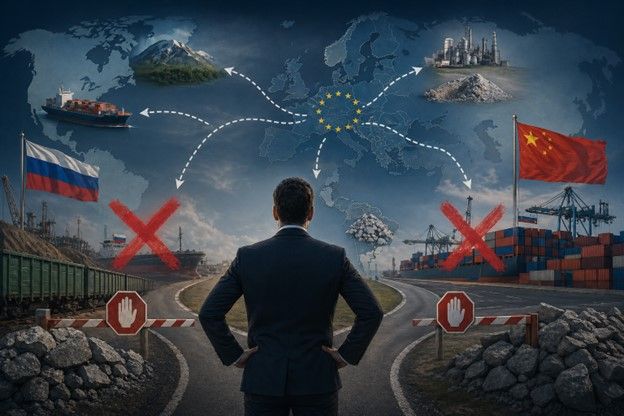
However, the European Commission has now moved to address this dependency. In January 2025, the Commission proposed introducing tariffs on Russian and Belarusian fertilizer imports, with an initial 13% duty to take effect from mid-2026, escalating toward effectively prohibitive levels over a three-year horizon. This policy shift will force a significant reorientation of European phosphate sourcing, accelerating a diversification that many operators have already begun but few have completed.
The question facing European supply chain managers is clear: if Russian phosphate becomes unavailable or prohibitively expensive, and Chinese supply remains constrained, where does the volume come from?
Morocco Moves to Center Stage
The answer, for now, points overwhelmingly toward Morocco — and specifically toward Morocco's state-owned OCP Group, which is the world's largest phosphate exporter and controls access to reserves that represent an unparalleled share of global deposits.
Morocco's centrality to global phosphate trade is only growing. Following China's export restrictions, Morocco's role as a critical swing supplier has become even more pronounced. OCP has announced a USD 1 billion commitment to sustainable mining and product innovation, and the company has been expanding its integrated phosphate and fertilizer production capacity, with further additions expected by 2027. State-owned under Morocco's Mining Code, OCP operates primarily through quarterly contracts with international buyers — a structure that gives it considerable pricing power and has recently prompted pricing methodology changes by major commodity assessors like S&P Global Platts.
For European buyers, this means a growing dependency on a single country and a single state-controlled entity. While Morocco is a reliable partner with well-established trade relationships with the EU, concentrating European phosphate sourcing around one supplier (however capable) does not solve the underlying vulnerability problem. It merely shifts its geography.
Other potential sources are emerging. Saudi Arabia, Jordan, and Senegal are all expanding capacity, and new mining projects are under development in Canada, Congo, and Guinea-Bissau, though most of these will not contribute meaningful volumes until after 2027 or 2028. In the medium term, Europe has limited alternatives to Morocco.
Phosphate Beyond Fertilizers: The EV Battery Dimension
One development that is often overlooked in discussions of phosphate supply is the rapidly growing demand from the electric vehicle battery sector. Lithium iron phosphate (LFP) batteries — now the dominant battery chemistry globally, with over 90% of all LFP batteries manufactured in China in 2024 — require high-purity phosphoric acid as a key input. As EV adoption scales, demand for battery-grade phosphate is compounding the pressure on already-constrained supplies.
This creates a genuine competition for phosphate resources between agriculture and clean energy — two sectors that are both critical priorities for European industrial policy. PhosAgro has developed a new low-cadmium fertilizer line to comply with upcoming EU regulations, and other producers are investing in phosphoric acid capacity for both fertilizer and battery applications. The dual-use nature of phosphate chemistry is increasingly shaping investment decisions across the supply chain.
The EU's Policy Response and What It Means for Industry
European policymakers have recognized the strategic nature of phosphate dependency, though responses remain fragmented. The EU's Farm to Fork Strategy and the broader Critical Raw Materials Act both contain provisions relevant to phosphate, but phosphate rock itself has not been formally classified as a critical raw material in all EU frameworks — an omission that contrasts sharply with its fundamental importance to food production.
On the recycling front, there is growing interest in recovering phosphorus from wastewater, sewage sludge, and animal waste streams. The European Sustainable Phosphorus Platform and various research programs have demonstrated that secondary phosphorus recovery is technically feasible and could meaningfully supplement import volumes. However, the economics remain challenging, and at current scales, recycled phosphorus cannot replace primary imports. Regulatory frameworks in several EU countries are beginning to create incentives for phosphorus recovery, but this is a decade-long transition rather than an immediate solution.
Long-term supply agreements are emerging as the most practical tool for near-term supply security. In 2023, more than 20 major phosphate supply contracts were signed globally, each covering between 500,000 and 2 million metric tons of annual supply. European companies that have secured long-term offtake agreements with Moroccan, Jordanian, or Saudi producers are in a considerably stronger position than those relying on spot market purchases.
Implications for Chemical Distributors and Supply Chain Operators
For businesses operating within European fertilizer, agrochemical, and specialty chemical supply chains, the implications of this landscape are significant and immediate.
Price volatility is now structural, not cyclical. Phosphate prices remain approximately double their pre-pandemic levels despite easing from the 2022 peaks, and the removal of Chinese export volumes means there is less buffer capacity in the global system to absorb future shocks. Supply chain operators should expect price swings to continue and plan procurement strategies accordingly.
Geographic concentration risk demands active management. Sourcing from a single country or supplier — whether Russia, Morocco, or any other — creates exposure that procurement teams must quantify and mitigate. Diversification across geographies and contract types (spot versus long-term) provides increasingly valuable resilience.
Compliance requirements are tightening. EU regulations on cadmium content in phosphate fertilizers, evolving import tariff regimes, and sustainability disclosure requirements are all adding complexity to phosphate procurement. Distributors who understand these regulatory trajectories are better positioned to advise customers and structure compliant supply arrangements.
New supply corridors are opening. As the market reorients away from Russia and China, alternative supply routes through West Africa, the Middle East, and eventually Central Asia are becoming more commercially relevant. Early engagement with producers in these regions — whether directly or through trading partnerships — offers first-mover advantages.
Looking Ahead
The phosphate supply challenge facing Europe is not a temporary disruption that will resolve itself when geopolitical conditions normalize. It reflects deep structural realities: concentrated reserves, a continent with no domestic production, rising demand from both agriculture and clean energy, and a shifting regulatory environment that is reducing access to historically important suppliers.
The market is adapting. New capacity is being built in Morocco, Brazil, Kazakhstan, and elsewhere. Phosphorus recycling is gaining regulatory and commercial traction. Long-term contracts are replacing the spot-market dependency that left many operators exposed during the 2021–2022 price spike. And European policy is slowly — perhaps too slowly — recognizing phosphate as the strategic resource it has always been.
For DECACHEM and the clients and partners we serve, navigating this environment requires staying ahead of market intelligence, maintaining flexible supply arrangements, and thinking about phosphate not as a commodity to be sourced opportunistically but as a critical input to be managed strategically. The rules of the phosphate market have changed. Supply chain strategies need to change with them.